
Differentiating Platform Compliance Freeze From Legal Seizure Constraints
Status: Published: Last reviewed: Editorial policy
A platform compliance freeze represents an internal decision by the exchange based on its specific rules. Conversely, a legal seizure follows an explicit mandate from an external entity, such as a court or prosecutor. Identify the controlling authority via the notice: check for case references, the initiating body's name, or non-disclosure statements. Release pathways vary by constraint type; legal orders require specialized legal representation.
Need a case detail checked? Send it here:
Two different holders of control
If a platform imposes a compliance freeze, the exchange determines the action while reviewing identity verification, fund sources, or system risk flags. If a legal freeze occurs, an external regulatory authority determines the action, and the platform executes the received mandate.
Both states manifest identically from the user account interface: withdrawals are disabled, and support outputs are restricted. The distinguishing factor resides in the specific entity permitted to terminate the operational constraint.
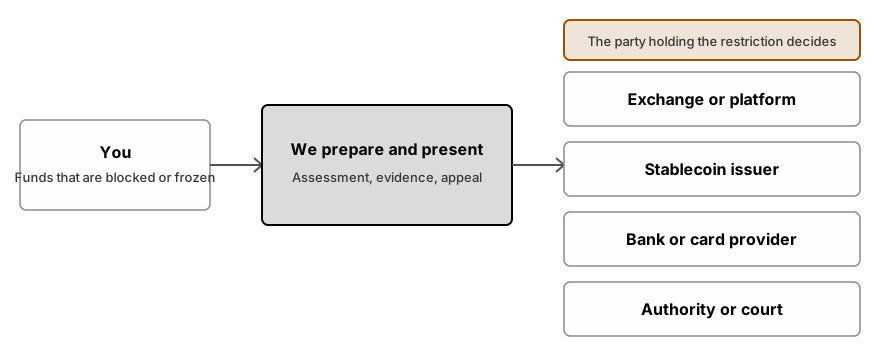
Markers that indicate each type
Any single indicator is not definitive evidence. Review the entire official notification and monitor all subsequent communication for complete context.
- Compliance freeze: the notice requests documents, refers to a review or verification, and provides a channel to reply.
- If the notice cites an order, a case number, a named authority or a formal request, treat the trigger as legal: freeze or seizure by that authority, with few other details given.
- A compliance freeze usually states a next step for you. A legal one usually states none, since the platform may be barred from explaining.
- Support that answers it cannot comment, or cannot see the reason, normally signals involvement of a separate team or an authority.
- A letter, email or call from an investigator or authority points to a legal route. Take it seriously and confirm the sender's identity.
Why the difference matters
With a compliance freeze, supplying what the platform requests often resolves it. A legal order sits outside platform control. Submitting additional documents to the exchange cannot alter an order, and may only postpone the correct step.
Contact from an authority also has legal consequences. Anything stated or submitted may enter a case, so improvised answers carry risk.
What each path looks like
A compliance freeze has a defined response path: reply to the exact request, submit evidence that backs your account of the funds, and, if the first reply is a rejection, escalate through the official appeals channel.
A legal freeze or seizure is controlled by the authority or the court, so the path runs through them. Step one: identify which authority issued the order. Step two: establish what the order is based on. Step three: check whether a procedure exists to challenge it or request release. Note the constraint: time limits may apply, and they differ between jurisdictions.
When a lawyer becomes necessary
Contact a qualified lawyer in the relevant jurisdiction as soon as an order or investigation appears to be involved. If a legal order triggers the freeze, a lawyer can read it, state your rights and deadlines, and communicate with the authority on your behalf.
No legal advice is given here. The service maps your case to one of the two paths, collects evidence, builds the file, and refers you to independent licensed lawyers. Lifting an order is outside our control. Seed phrases, private keys and passwords are never requested; never send them to anyone.
Frequently asked questions
Will an exchange disclose that law enforcement caused the freeze?
Not always. A court or agency order can bar the platform from disclosing details. If the exchange states it cannot comment, ask whether the matter sits with a legal team, and save its written response as evidence.
Is recovery of crypto assets contingent upon the specific mechanism used for seizure?
The outcome is dependent on case parameters and the governing legal framework. Release requires verification of legal ownership record and completion of a formal process before the relevant governing body. Local legal counsel must provide input to determine the required steps.
Should I contact the authority directly?
Seek legal advice before you say anything, if that option is open to you. Statements you make can become evidence in the case. If an authority has contacted you, do not reply from the message itself. Find the authority's official contact details through an independent source, then verify that the message is genuine before any further step.
What if I cannot determine which kind of freeze applies to me?
Request, in writing, that the platform state the basis of the restriction and the contact to use. Pass that notice to a specialist for a free assessment. We help you interpret the signs; the platform's decision is outside our control.
How we can help
- Diagnosing a crypto freeze. Identify the party behind a freeze and the realistic next step.
- When authorities freeze your crypto. When authorities hold your crypto, we arrange independent licensed lawyers. We give no legal advice.
- Unblocking a restricted exchange account. Read the freeze, build KYC and AML evidence, answer compliance, appeal.
- Regulator and Ombudsman Filings. Construct a formal regulator, ombudsman, or consumer complaint including a precise timeline.
The content on this page is general. It is not legal advice.