
Blocked because of a sanctions or AML false positive: how the challenge process works
Status: Published: Last reviewed: Editorial policy
A false positive is an error: screening software links your name, address or a counterparty to a sanctions list or risk category when the match is wrong. Shared names and indirect exposure trigger it often. Clearing it requires evidence that you are not the listed party, usually filed by a lawyer. We prepare that evidence and coordinate independent licensed lawyers. If the match is real, we cannot help you avoid it.
Need a case detail checked? Send it here:
What we do
- Identify what was actually matched
The mechanism matters: the flag may sit on you, an address, a counterparty, or a transaction path. Each carries a different remedy. We record the matched item, plus the list or category the provider relied on.
- Tell a false positive apart from a real match
We check your identity data against the listed entry: name variants, dates, places, identifiers, roles. If the evidence points to a genuine match, we say so plainly and stop there.
- Assemble the evidence pack
Collect every record before contacting anyone. Gather identity documents, proof of address, company records, the full history of the funds, and any document showing no link to the listed party. Sort the input so each item has a source and a date. The output is one evidence package a lawyer can use without further cleanup.
- Give independent lawyers the file
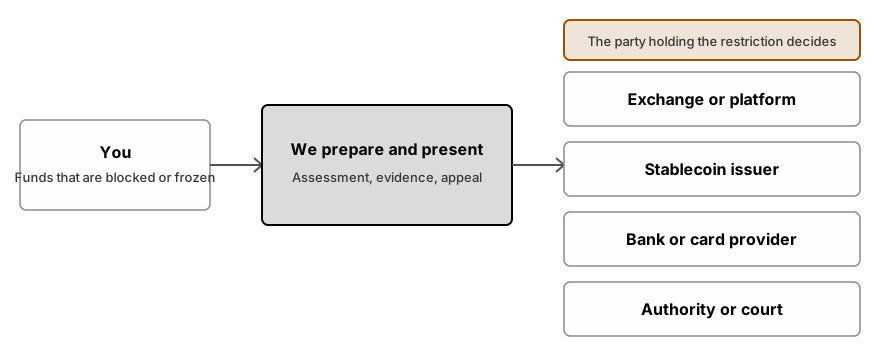
Independent licensed lawyers make the legal submissions; we do not. Our part is preparation: assemble facts and exhibits, set the scope with you and the lawyer, and keep the file coordinated until the process ends.
- Follow up with the provider
If the compliance team sends extra questions, we coordinate the answers and track the ticket to a logged outcome. The lawyer decides whether to use a review route where a regulator or listing authority provides one.
How a case runs
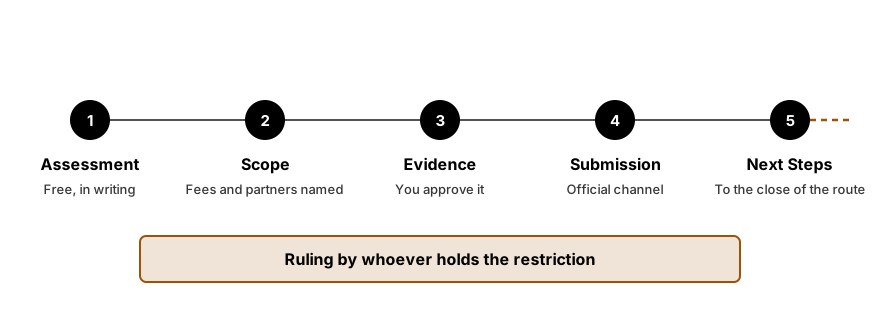
- Free initial review
You give the flag description and the notices. We state in writing if the flag appears to be a false positive, if we can assist, and what evidence is required.
- Scope in writing, plus fee
Before any payment, we send you the scope document, our fee structure, and the independent lawyer's written terms. You receive these items if we proceed with the case.
- Evidence gathering
You send documents via a secure channel. We inspect them for omissions or inconsistencies with the listed entry, then forward them to the lawyer.
- Send to lawyer
An independent counsel prepares documentation and submits the request through the proper channel. Copies and reference numbers are issued to you.
- Next Steps
We monitor communication responses, assist with follow up, and confirm if the automated match is genuine or the submission path is exhausted.
Inputs to prepare
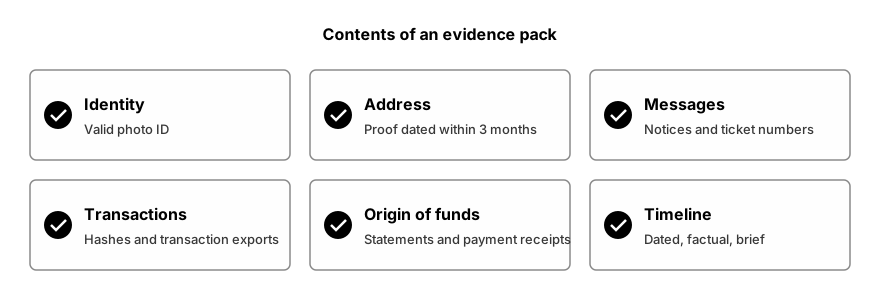
- Government-issued ID: passport or national card, displaying complete name plus birth date and birthplace
- Proof of address and corporate registration records for legal entities including ownership structure.
- The provider's notice flagging the item, including associated dates and reference numbers.
- Transaction records for each wallet or account that is part of the case
- Documentation detailing the source and origin of the funds that were flagged in the system.
- Previous clearance documents or screening results currently retained by the applicant.
- A brief written statement asserting that the submitter is not the designated person or entity.
What we cannot do
- The process terminates if a verifiable sanction match is determined; we do not assist in avoiding genuine sanctions.
- We cannot compel any provider, regulator or listing authority to clear a flag. The decision rests with them, and some of those decisions take a long time.
- Submissions of a legal nature come only from independent licensed lawyers. Our role is evidence preparation and coordination; we do not deliver legal advice ourselves.
- We will not request your seed phrase, private keys, or passwords.
Common situations
- A common name collides with a listed person who shares a date of birth or country of origin
- A home or company address sits near a listed party, or inside a sensitive jurisdiction
- An incoming transfer traces back across several hops to a service later added to a sanctions list
- A counterparty or customer matches a list entry describing another company
- Analytics software flags a wallet, with no stated reason for the exposure
- Funds sit on hold while the compliance team awaits a legal review of the match
This fits your case if
- Your name closely matches a listed person's, and the account is now frozen
- A bank or exchange states that a counterparty or address you used is sanctioned or high risk
- Funds arrived through a service listed only later, and you did not know its status at the time
- A screening tool assigned your wallet a risk label you consider incorrect
- The account was closed for compliance reasons, with no detail provided beyond that
How long it takes
A provider-side false positive cleared at that level can run days to weeks. A formal review before an authority can run months. The estimate follows the assessment and is revised as the case state changes.
Fees
The assessment costs nothing. Its output is a written scope plus a fee model, covering the independent lawyer's fees, delivered before you commit. No fee is requested before we state whether help is possible. Fees →
Questions people ask
What does the term sanctions false positive mean?
A false positive is an incorrect match. Screening software checks names, addresses and wallets against lists and risk categories. If the data is similar but not identical, an innocent person can be flagged. A human reviewer is meant to clear the flag, yet this step is not always fast.
How do I distinguish a false positive from a true match?
Check your identity data against the listed entry: full name, date of birth, place, identifiers and role. If those fields differ, a false positive is likely. If they align, treat it as a genuine match and stop any dealing with the funds until a lawyer advises.
Will you assist if the match is real?
No. Assisting anyone in dodging real sanctions is outside our scope. When the assessment confirms the flag is correct, we state that in writing and close the file. Early honest input stops the situation from getting worse.
Why does this work require a lawyer?
Removing a flag or contesting a listing is a legal filing with legal consequences. Licensed independent lawyers must make it. We assemble the evidence and coordinate, so the lawyer receives a clean file.
Can a wallet get flagged even when I did nothing wrong?
Yes. A wallet may accept funds that earlier passed through a listed service, several transactions back. Analytics tools can score that exposure as high risk. Exposure is not guilt, but you will generally need to document the funds' origin.
While the case is open, should I transfer the funds to another account?
Do not. Transfers of flagged funds can read as concealment and may complicate the case. Halt activity on the flagged account, retain every message, and wait for the lawyer's advice.
Related situations
- Wallet risk flags and how to dispute them. Screening tool flags your address as high risk: record the fund path and dispute it.
- Sourcing of funds and wealth: document packs. Build a clear source of funds and source of wealth pack for exchanges, banks and processors.
- Unblocking a restricted exchange account. Read the freeze, build KYC and AML evidence, answer compliance, appeal.
- When authorities freeze your crypto. When authorities hold your crypto, we arrange independent licensed lawyers. We give no legal advice.
Read next
Sources
This record is derived from external, primary sources. Validation depends on the source documentation. Changes occur; review the originating platform for current content.
- Does Coinbase freeze accounts? · Coinbase
The content on this page is general. It is not legal advice.