
Exchange account freezes: the usual triggers and how to read them
Status: Published: Last reviewed: Editorial policy
Five triggers account for most freezes: an unfinished or failed identity check, an AML flag on funds received, activity that does not match the profile, a new location or device, and a legal or regulatory request. The notice often gives only a category. First action: read it closely and answer exactly what it asks.
Need a case detail checked? Send it here:
A freeze is a compliance state, not a finding of guilt
A regulated exchange is required to verify customers and monitor transactions. If an automated rule or a human reviewer finds an item that needs explaining, the account moves to a restricted state and stays there until the review closes.
Usually nothing is alleged against the account. It waits on information the exchange must obtain. For that reason, the content and completeness of your answer outweigh the force of any complaint.
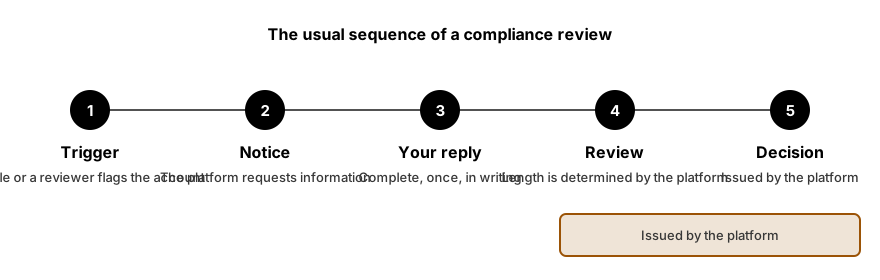
Five typical triggers
These are general patterns. Every exchange applies its own rules, and the notice may not reveal which trigger fired.
- Identity verification: expired, unreadable or mismatched documents, documents flagged as possibly altered, or a verification tier too low for your current activity.
- Flag on incoming funds: an analytics provider ties the sending address to risky services, or the exchange cannot establish where the deposit originated.
- Profile mismatch: volumes, speed or counterparties that differ from what the account declared.
- Location and device change: logins from a new country, from a network pointing to a restricted jurisdiction, or with signs that another person uses the account.
- Legal or regulatory input: a court order, a law enforcement request or a sanctions-related match.
Reading the notice
Extract three inputs from it: what the exchange asks for, the deadline and the channel. A source-of-funds request is a different case from an identity re-verification, even when both sit under the same ticket title.
If the message is generic, keep it and ask one precise question: which information is needed to complete the review. Keep every reply in writing.
Actions for the first days
Target output for the first days: one complete, consistent answer, sent once, through the channel the exchange named.
- Do not shuffle funds between wallets or exchanges to dodge the freeze. Each new transfer adds activity that will need explaining.
- Gather documents proving where the funds came from: bank statements, purchase receipts, earlier exchange exports.
- Answer via the official channel named in the notice, and record the reference number.
- Hand over no seed phrase, private key or password to anyone who offers help, and especially not to anyone who approached you first.
When outside help pays off
Structured support saves time in four situations: the review has no end date, answers keep being rejected, a large amount is involved, or the flag looks like a false positive. A specialist can reconstruct the question behind the notice, test the evidence for gaps and draft the response.
No outcome is promised. The exchange decides, and some cases have no route at all. A competent adviser says so early.
Frequently asked questions
What is the maximum duration of an exchange freeze?
No single limit applies. Duration depends on the exchange, the reason and the speed of the answers. Many reviews close once the requested documents are supplied; others stay open while the exchange waits on an authority.
Are withdrawals possible during a review?
Usually restricted. Some exchanges permit withdrawal to a verified bank account or back to the original source address. Ask the exchange which options exist in your case.
Does a freeze imply a criminal accusation?
Not in itself. Most freezes are routine compliance steps. A legal request is a different matter, and the notice usually says so.
Is paying for a promised fast unfreeze safe?
No, treat it with great caution. Nobody outside the exchange can unfreeze an account on demand. Watch for advance payments, promised results and any request for a seed phrase or password.
How we can help
- Unblocking a restricted exchange account. Read the freeze, build KYC and AML evidence, answer compliance, appeal.
- Diagnosing a crypto freeze. Identify the party behind a freeze and the realistic next step.
- Sourcing of funds and wealth: document packs. Build a clear source of funds and source of wealth pack for exchanges, banks and processors.
The content on this page is general. It is not legal advice.