
USDT address frozen: what a Tether freeze does to your funds, and the steps you can take
Status: Published: Last reviewed: Editorial policy
If an address holding USDT is frozen, the tokens remain visible on-chain but any transfer fails. The control sits at the token contract level; your wallet app and any exchange cannot override it. Typical triggers: a law enforcement request or a compliance flag. Only the party that applied the freeze, or a court, can remove it. Moving funds to a new wallet or paying a stranger changes nothing.
Need a case detail checked? Send it here:
What a frozen USDT address actually is
USDT is a token issued by a company, and its contract gives the issuer the ability to block chosen addresses from sending or receiving it. If that switch is set on your address, the balance still appears on a block explorer. The tokens simply cannot leave.
An exchange freeze and this are not the same thing. An exchange holds control only over its own platform. A token level freeze attaches to the address itself, so the restriction moves with it wherever the address is used. Switching to a new wallet app, another device or a different exchange does not lift that state.
Verifying the freeze: how to check it is genuine
Treat a failed transfer as an unconfirmed event, not as proof of a freeze. The trigger can be a network fee set too low, a mismatched network selection, or a wallet defect. Check the actual record before you act on any assumption.
Open the block explorer for the network you actually use and search your address there. Many explorers display a label or flag on restricted addresses; a reverted transaction often carries a reason code. Capture screenshots and record the date and time.
- Confirm the token sits on the network you are checking, ideally the network where the funds arrived.
- Confirm the wallet holds enough of that network's native coin to cover the fee.
- On the explorer, open the address and your most recent failed transaction, then save both pages.
- If the fee is clearly not the cause, send a minimal test amount of USDT. Do not repeat large attempts.
- List every transaction from recent months that touched the address, noting counterparty and purpose.
Why addresses get frozen
Per-case causes are typically not made public. Two patterns account for most reports: a law enforcement request, and a compliance flag raised by the issuer or by its analytics tooling.
An authority request often connects to an investigation of someone else, such as a scam or theft. Your address may have received from, or sent to, an address tied to that case. A compliance flag follows the same pattern but begins with screening, not a court or police request. Neither pattern means you are accused of anything.
Which parties hold the power to unfreeze, and which do not
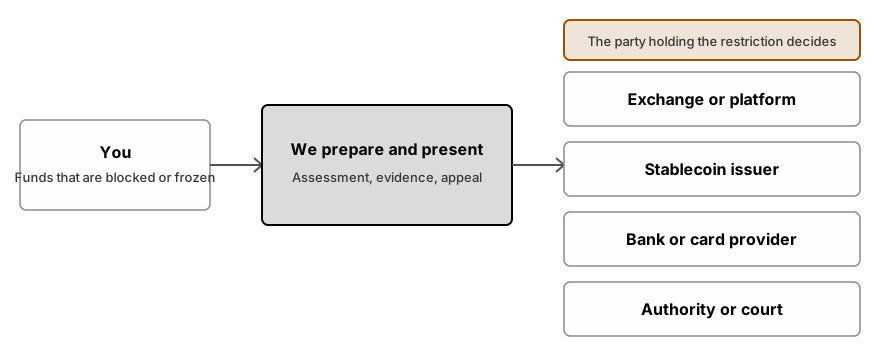
Removal of the restriction sits with whoever controls it. Operationally, that is the issuer, either through its own review or on instruction from the authority that triggered the freeze, or a court that issues an order.
Exchanges, wallet makers, explorers and support desks have no control over it. Neither do we. If someone offers to unfreeze your address for a fee without going through the issuer or the authority, that person is mistaken or selling something.
Permitted and prohibited steps
You may reach the issuer via its official support or legal channel and ask two things: which restriction type applies, and what input is required. If an authority is involved, you may also have a lawyer write to it.
You cannot compel a decision, and attempts to route around the freeze carry risk. Moving remaining assets through mixers or fresh wallets can read as evasion and can complicate the review.
- Retain the address, the explorer screenshots and the complete record of how the funds arrived.
- Collect evidence showing where the funds came from: exchange statements, bank transfer records, invoices and signed contracts.
- Contact the issuer only through channels published on its official website; ignore links sent to you.
- Maintain a written log of every message, including dates and reference numbers.
- Never share your seed phrase, private key or password with anyone offering assistance.
A reasonable next step
First, write a one page timeline: when the USDT arrived, who sent it, why, and what happened to it afterward. This document is the first input that any issuer, authority or lawyer will request.
If a significant asset volume is frozen or a legal order is implicated, consult local counsel. We coordinate legal and technical resources, but address release is not guaranteed.
Frequently asked questions
If Tether freezes an address, can the USDT balance still be viewed on-chain?
Yes. The balance stays visible on the blockchain and in most wallets. What changes is the state of the token contract: it blocks outgoing transfers, so sending, swapping and selling are all disabled.
If an address is frozen, does that trigger a police investigation into me?
No. A freeze can be triggered by a request concerning someone else whose funds passed through your address, or by an automated compliance check. Treat it as a signal to collect your records and seek advice; it is not proof of suspicion against you.
If I shift my funds to a different wallet, will the freeze lift?
No. The restriction sits on the address, so the frozen tokens cannot be moved. A new wallet has no effect on them, and receiving new funds into it from a flagged address can raise fresh questions.
How long does a USDT freeze last?
No fixed period exists that we can state. Some restrictions remain while an authority works a case; others are lifted after a review. Ask the issuer which type applies, and keep your evidence ready.
Is paying someone to unfreeze my USDT safe?
Treat this with caution. Only the issuer, the requesting authority or a court holds the control to lift the freeze; no outside party can change that state. Upfront payment demands, promised outcomes, or any request for your seed phrase are markers of a recovery scam.
How we can help
- Appealing a stablecoin issuer freeze. Evidence-backed appeal for a freeze by Tether, Circle or a comparable issuer.
- Unblocking a crypto wallet. Case preparation and presentation for frozen or flagged wallets, from USD 50,000.
- When authorities freeze your crypto. When authorities hold your crypto, we arrange independent licensed lawyers. We give no legal advice.
- Diagnosing a crypto freeze. Identify the party behind a freeze and the realistic next step.
The content on this page is general. It is not legal advice.