Blockchain analytics report: trace where your funds came from, for compliance
Status: Published: Last reviewed: Editorial policy
A blockchain analytics report sets out how funds reached an address: which transfers, via which counterparties, carrying which risk flags. Independent specialists compile it from public ledger data; we convert it into a document a compliance team can read. It can display the path of funds. It cannot prove who controlled an address, why a payment was made, or that any platform must accept it.
Need a case detail checked? Send it here:
What we do
- State the question the report must answer
We fix the exact question first: the origin of one deposit, the history of one wallet, or exposure to a flagged counterparty. A narrow question yields a document a reviewer can actually use.
- Hand transaction tracing to independent specialists
Independent analysts follow the transfers on the public ledger, label identifiable counterparties and log each hop. We choose them, brief them, and check the scope against your question.
- Flag risks and state what each one means
The report flags any exposure to categories: exchanges, mixers, sanctioned entities or scam-linked addresses. Each flag comes with a plain-word explanation and the transfers that triggered it.
- Compare chain data against your own records
If you provide bank statements, receipts and exchange exports, we connect them to the traced transfers. The report then presents one consistent story rather than a list of hashes. Ledger data alone lacks sufficient detail for this.
- Produce a document the reviewer can read
You receive a structured report: a summary, a path of funds, a table of transfers and a brief note on method and limits. You choose whether to send it to the platform or the lawyer.
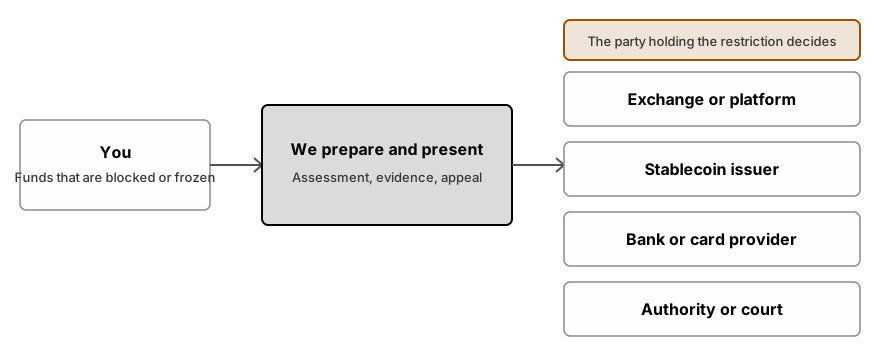
How a case runs
- Free initial review
You state who asked for what and why. We answer in writing whether a report would help and what it would have to contain.
- Scope in writing, plus fee
Before any payment, you receive the question, the addresses in scope, the involved specialists, and the fee model.
- Trace the funds
Specialists trace transfer movements and assign labels to counterparties. We assess the resulting draft for discrepancies and for data unsupported statements.
- Cross-checking the records
We compare the blockchain record chronology with the provided documents. We identify any discrepancies and obtain clarification regarding these mismatches prior to final report closure.
- Delivery and Reporting
The final output includes the report and a concise presentation guide. We facilitate the submission of these documents to the relevant platform or counsel.
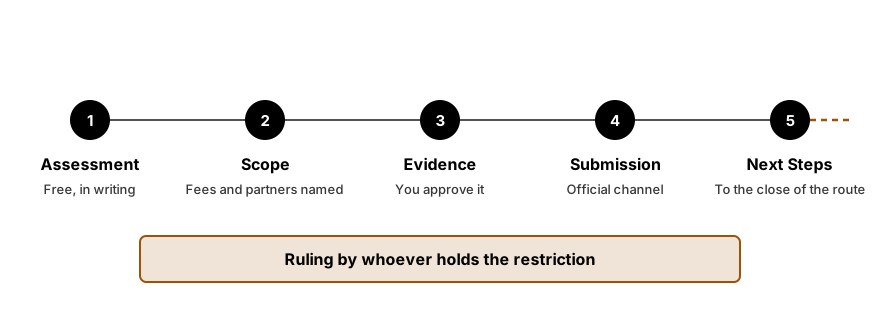
Inputs to prepare
- List of wallet addresses included in the scope, and identity of controlled accounts.
- Transaction hashes or specified dates, along with the amounts of transfers that require examination.
- The specific query or requirement issued by the platform, bank, or legal representative.
- Exchange exports plus trade history covering the period
- Bank statements or receipts documenting the initial purchase mechanism of the funds.
- Any prior report, risk score or screening output that was shown to you
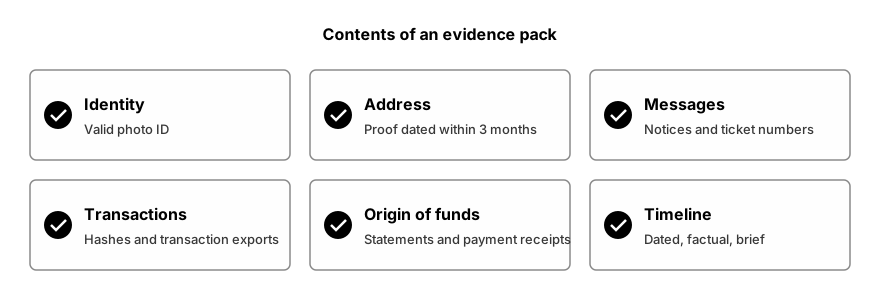
What we cannot do
- A report traces the flow of funds on the public ledger. It does not establish who controls an address, why a payment was made, or that the funds are clean.
- Labels for counterparties derive from analytics data and may be incomplete or inaccurate. We state the confidence level and the basis for it.
- A platform may disregard a report. We cannot compel a compliance team, issuer or authority to accept it or to reverse a decision.
- Privacy tools, cross-chain bridges and off-chain trades can sever the trace. The report states the point where the trail ends.
- We never request your seed phrase, private keys or passwords. Tracing requires public addresses only.
Common situations
- An exchange demands source-of-funds proof for a large deposit
- Assets bought on the market, moved between your own wallets, then flagged
- A payment arrived, and the sending address later showed a risk label
- A bank asks where the money from a crypto sale originated
- An old wallet must have its history explained before any use
- A dispute or appeal needs an exhibit built from evidence
This fits your case if
- A compliance team asks where your crypto originated, and your own records have gaps
- Funds reached you through several hops, and the path needs to be laid out clearly
- When a platform marks a deposit, you can check what the automated screening likely detected.
- When a lawyer or an accountant requires an impartial on-chain record summary, prepare one
- You plan to receive a large transfer and want the address vetted first
How long it takes
The operational timeframe is constrained by three variables: address count, tracing depth, and the speed of record input. An estimate will be generated following the completed assessment.
Fees
No charge applies to the assessment. Report fees vary with scope and complexity; we state them in writing before payment. No fee is due before we say whether a report would help. Fees →
Questions people ask
Which parts make up a blockchain analysis report on source of funds?
The report contains six parts: a summary, a funds path from the earliest identifiable source up to your address, a table of transfers, counterparties with labels, risk flags each with an explanation, and a note on method and limits. The intended reader works in compliance, not engineering. Do not expect deep technical detail.
Does a blockchain report establish that my funds are legitimate?
No. The report traces the path of the funds and lists the labels attached to each counterparty. Whether the money is legitimate depends on how you acquired it, so we pair the analytics output with your bank statements and purchase records.
Will an exchange accept this report?
Some compliance teams treat it as useful input, others run their own tools and read it only as context. We cannot promise acceptance. A clear report backed by matching documents usually carries more weight than raw transaction lists.
Do you need access to my wallet?
No. A tracing exercise works from public addresses and transaction hashes, nothing else. Anyone who requests a seed phrase, private key or password for a report should be treated as unsafe, and no legitimate analyst will ask for them.
What happens if the trace passes through a mixer or a bridge?
Where the trail stops being verifiable, the report marks that point and records what is known on both sides of it. Follow-through varies by tool: some bridges can be traced across, mixers generally break the record. When tracing hits that limit, we record the limit itself instead of producing a guess.
Is this the same thing as a risk score?
Risk scores constitute a scalar value generated by an automated screening system. The accompanying report details the transfer events that generated that value. This documentation permits the user to challenge any score that deviates from the established transaction evidence.
Related situations
- Diagnosing a crypto freeze. Identify the party behind a freeze and the realistic next step.
- Sourcing of funds and wealth: document packs. Build a clear source of funds and source of wealth pack for exchanges, banks and processors.
- Wallet risk flags and how to dispute them. Screening tool flags your address as high risk: record the fund path and dispute it.
- Tracing stolen crypto, sending freeze requests. Tracing, freeze requests to exchanges and issuers, and police report support.
Read next
The content on this page is general. It is not legal advice.