
USDC address blocked: how the Circle blacklist operates and the next steps
Status: Published: Last reviewed: Editorial policy
Circle, the USDC issuer, can add an address to its blocklist. The check runs at the token contract level: transfers from a listed address are rejected, while the on-chain balance remains visible. Triggers include a legal order, sanctions screening and risk flags. Wallets, exchanges and block explorers have no control over this state and cannot remove it. The working path is a documented request to the issuer, normally handled with a lawyer.
Need a case detail checked? Send it here:
Indicators that the restriction is on the address, not the app
The USDC balance displays in your wallet, yet every transfer fails. Swaps via decentralised services also fail. Tokens other than USDC in the same wallet move without error. This output pattern indicates a restriction at the USDC contract level, not a fault in the wallet application.
Do not conclude that a blacklist applies until common causes are excluded. An incorrect network, an empty gas balance and network congestion each produce failed sends.
- Transfer a small amount of a different token from the same address. A successful transfer means the wallet itself is working.
- Open the block explorer, find the rejected transaction, and check the error message it shows.
- Where the chain data permits it, open the USDC contract page and search its blocklist events for that address.
- Take screenshots and record the date and time on each one.
How issuer blacklists work
USDC is a centrally issued, regulated stablecoin. Its contract contains a function that allows the issuer to place an address on a blocklist. Once an address is listed, transfers of the token on that network are blocked in both directions.
This control is built into fiat backed stablecoins by design; it is neither a bug nor a hack. Its purpose is to let the issuer comply with legal orders and sanctions rules. A consequence follows: a decision taken inside one office can block funds in a wallet only you control.
Common blocklist triggers
The issuer seldom gives a reason for a single decision. Public discussion points to a small number of trigger groups. Read this list as a set of possibilities, not as a diagnosis of your case.
- An instruction from a public authority or a court order connected to an investigation.
- Sanctions screening, when an address appears linked to a listed person or service.
- Blockchain analytics linking the address to others tied to fraud, theft or hacks.
- A request from a partner exchange, or from a financial institution handling the token.
Who decides, and what they examine
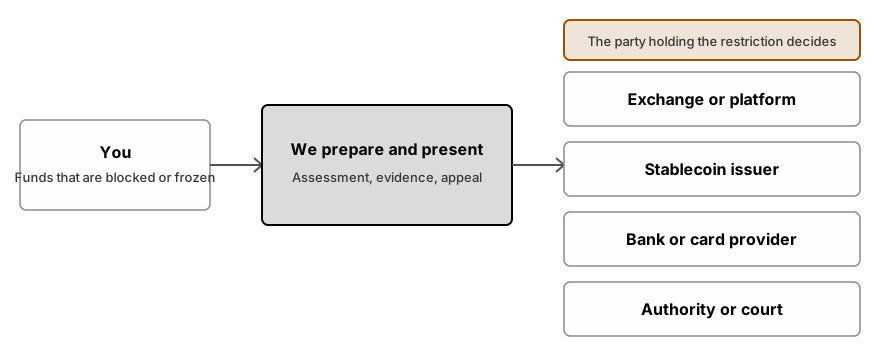
The issuer holds the decision, and in some cases the authority behind a request does. Neither usually speaks with a third party that lacks a mandate from you.
A review checks the source of the funds, who held them before you, and whether each transfer has a clear commercial or personal reason you can show. Gaps in that story slow cases down. Evidence of legitimate origin is the strongest input you can supply.
Steps available to you
The main route is a written request to the issuer through its official legal or support channel, stating your identity, the address, the dates and evidence of origin. If an authority is involved, a lawyer in that jurisdiction may need to send it.
No outcome is fixed. The issuer holds the control and can release the address, keep the block in place, or state that only a court order decides the matter. Which path applies depends on the issuer's policy and is not verifiable from outside. We coordinate the process; we do not issue rulings and no result is guaranteed.
- Build a timeline of how the USDC reached the address.
- Obtain evidence: exchange records, bank transfers, invoices, contracts.
- Show control of the address without exposing your keys, for instance with a signed message.
- Submit one comprehensive request rather than multiple segmented ones.
- Do not pass a seed phrase, private key or password to any party, under any circumstance.
Actions to hold off on during the wait
If funds are flagged, then send no test transfers to fresh addresses. Do not mix or bridge assets you still control. Each such move creates new records and can read as an attempt to obscure the origin.
Treat any message claiming a link to the issuer, or a paid offer to unblock the address, as suspect. If you want a second check on your documents before contacting the issuer, we provide a free assessment and can engage independent lawyers.
Frequently asked questions
Can an exchange release my USDC if Circle has it blocked?
No. A restriction inside the token contract is outside an exchange's control. An exchange controls only funds held on its own platform. The issuer is the sole party able to change an address's status.
Can a Circle blocklisting be lifted, or is it permanent?
The outcome depends on the issuer's internal review or a court decision. Some restrictions lift after review; others remain while a legal matter is unresolved. Contact the issuer to learn which case applies to your address. We cannot predict the result.
Can the issuer provide a reason when an address is blocked?
When an authority triggers a block, the provided detail is typically general or non-existent. A lawyer can acquire greater specificity via a formal request than an individual can obtain.
Does the blocked USDC address currently accept incoming transfers?
Receiving funds is usually restricted when an address is blocklisted. The address is constrained for both sending and receiving operations. Direct no funds toward it, because the assets may be stuck.
Is legal representation required to communicate with the fund issuer?
Legal counsel is not always a requirement. A private request supported by sufficient evidence may suffice for simpler cases. Legal assistance is needed when asset totals are high, when an authority dictates the block, or when an initial request receives no output.
How we can help
- Appealing a stablecoin issuer freeze. Evidence-backed appeal for a freeze by Tether, Circle or a comparable issuer.
- Unblocking a crypto wallet. Case preparation and presentation for frozen or flagged wallets, from USD 50,000.
- Blockchain analysis report. A source-of-funds report built by tracing transactions, formatted for a compliance team.
- Sanctions and AML false positives: support. Wrong sanctions or AML match: evidence pack plus a lawyer-filed statement to clear the flag.
The content on this page is general. It is not legal advice.