Source of funds and source of wealth: what separates them and how each can be evidenced
Status: Published: Last reviewed: Editorial policy
Source of funds answers a narrow question: where did the money in this transaction originate? Source of wealth answers a wider one: how did your total assets accumulate over time? Exchanges trigger the first check on a specific deposit and the second on large or high risk accounts. Each check requires documents matching the actual origin.
Need a case detail checked? Send it here:
Two questions that sound alike
Source of funds is narrow. It concerns the money in one specific transfer, such as the deposit that triggered a review. The reviewer needs the path from that money's origin to the exchange.
Source of wealth is broad. It records how your total assets came to exist: years of employment, a business, an inheritance or investment gains. It provides context, so the reviewer can judge whether the deposit size fits your stated history.
Why exchanges request one or the other
A source of funds request traces back to one specific trigger: a large deposit, a transfer from an address not seen before, or a counterparty that got flagged. A source of wealth request depends on the account state instead. If the balance is large, the risk profile is high, or the activity far exceeds declared income, expect that request.
Some requests require both. Answer each one in a separate section, so the reviewer can tick it off without searching.
Origins and matching evidence
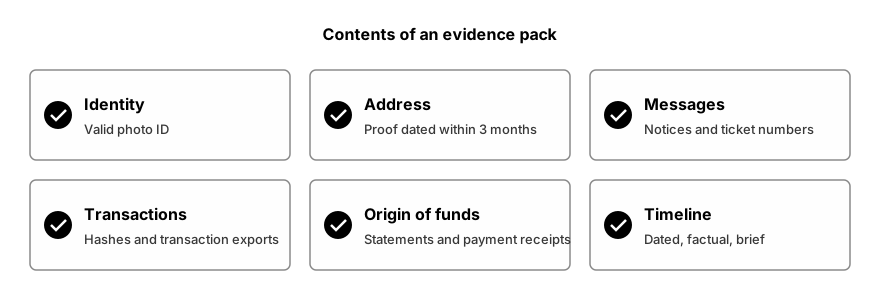
Which evidence fits depends on the origin of the funds. A document that proves one origin may prove nothing for another. Treat the list below as a starting point, then adjust it to your case.
- Salary: payslips, the signed employment contract, and bank records showing both the incoming salary and the transfer to the exchange.
- Trading profits: exports from the exchanges where you traded, plus platform statements and withdrawal records that connect to the current deposit.
- Mining: documentation of the rig or setup, the payout history from the pool, and the wallet addresses that received those payouts.
- Sale of property or a vehicle: the sale contract, proof of payment received, and the bank record showing the proceeds.
- Gift: a signed gift letter naming the donor, proof of the donor's funds if the reviewer asks, and the bank record of the transfer.
- Inheritance: a will or court document, evidence of the estate's value, and the record showing the payment made to you.
Connecting the documents into one chain
A stack of documents takes effort to review. A short written account takes minutes. For each origin of funds, write three or four sentences: what the money was, when it arrived, how it moved, and which file supports each step.
If funds passed through multiple wallets or platforms, then list each hop in order with dates and amounts. Every figure in the narrative must match the figures in the records. Mismatches are the most frequent cause of a rejected response.
Common gaps and how to fill them
Records are rarely complete. Cash savings, money received from a friend, a closed account or documents in another language are all common. None of these gaps is fatal if you state them plainly.
Supply the closest available substitute and state why the original is unavailable. A signed statement from the counterparty, a notarised letter or an official copy requested from a bank can cover the gap. Never invent or alter a document. A falsified paper causes more damage than a missing one.
- Ask your bank or platform for old statements; many retain records for several years.
- Translate any document that is not in the language the exchange uses.
- State every amount in the currency of origin, and record the date and rate used for conversion.
- Support a cash origin with a savings history, not only with a declared intention.
What to do next
Reread the request and tag which of the two questions it poses. Then assemble one file per origin, plus a cover note ordered to match those questions.
When a mixed origin is unclear, or an exchange has already rejected an earlier answer, submit your documents to us for a free review. We identify the gaps, prepare the package with you, and coordinate independent specialists where needed. The exchange holds the final control and makes the decision.
Frequently asked questions
Do source of funds and source of wealth mean the same thing?
No. Source of funds tracks the origin of money for one specific transaction. Source of wealth describes how you accumulated your total assets. A reviewer can request either or both. Each requires a separate explanation and supporting documents.
Is a tax return required as evidence when proving source of wealth?
No. A tax return is strong evidence for income from work or a business, but it is not the only accepted input. Payslips, sale contracts and bank statements can each support a wealth claim too. Match the document type to the origin you describe, because the check compares the stated source against the records you supply.
Can a gift qualify as a source of funds?
Documentation of the source of funds requires specific evidence. Required data points include a signed donor letter, identity details for the donor, and records of the bank transfer. Some exchanges also mandate documentation proving the donor’s source of wealth acquisition.
Do earlier crypto gains count as a valid source of funds?
The verification requires three sequential records: the fiat purchase, the trading history, and the withdrawals to the current deposit. Platform export files and bank statements serve as the standard evidence. Any missing segment in the chain must be accounted for, not omitted.
How far back must the documentation reach?
Go back until you reach a clear, documented origin of the funds. In many cases that span is a few years. The exchange may state a required period. If no period is stated, ask which time frame it expects.
How we can help
- Sourcing of funds and wealth: document packs. Build a clear source of funds and source of wealth pack for exchanges, banks and processors.
- Unblocking a restricted exchange account. Read the freeze, build KYC and AML evidence, answer compliance, appeal.
- Sanctions and AML false positives: support. Wrong sanctions or AML match: evidence pack plus a lawyer-filed statement to clear the flag.
- Diagnosing a crypto freeze. Identify the party behind a freeze and the realistic next step.
The content on this page is general. It is not legal advice.