
Family must access crypto of a person who died or lost capacity
Status: Published: Last reviewed: Editorial policy
When someone dies or loses the ability to manage their affairs, relatives often find no way into their crypto. The lawful route depends on legal documents, a search for wallets and exchange accounts, and the exchange's own process for deceased accounts. Independent lawyers and technical specialists handle the legal and technical work. Our role is coordination. We do not hack, guess passwords or bypass security.
Need a case detail checked? Send it here:
Technical work on this service is done by independent partner specialists. We vet them, coordinate the case and stay your single point of contact.
What we do
- Document all extant asset records
We review emails, bank statements, devices and paper records for evidence of exchange accounts, wallets or purchases. Output is two lists: platforms to contact and items that may need technical work.
- Identify which legal authority applies to you
Exchanges typically require proof of death, proof of your authority, for example a court grant or power of attorney, plus identity documents. Requirements vary by country. An independent lawyer confirms what your case requires.
- Submit a formal request through the exchange's established procedure
Prepare and submit a request to each exchange's deceased-account or incapacity team. Put the required documents in the order the platform expects. Keep a written record of every reply received.
- Engage independent lawyers and technical specialists
Independent licensed lawyers execute legal proceedings. If a wallet file or physical device is involved, independent specialists attempt lawful access. The service vets and coordinates the output of these external parties.
- Record the assets and secure them
After assets are located, we help you document them for the estate, transfer them to wallets the rightful owner controls, and maintain an audit trail for the executor, the family and any tax adviser.
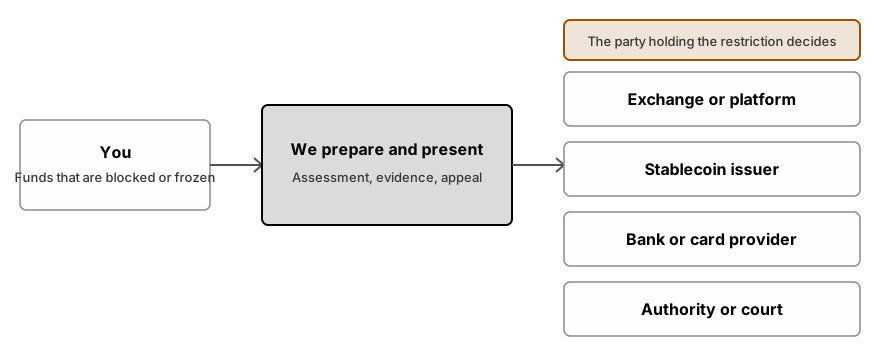
How a case runs
- Free initial review
State who the person was, what you know and which papers exist. We respond in writing on what looks feasible, what the first legal step might be and whether we can assist.
- Scope and initial introductions
If the case proceeds, we issue a written scope and a fee model, then introduce the independent lawyer and specialists involved. You set terms with each of them directly.
- Search and legal foundation work
Gather documents via a secure channel. The lawyer verifies your current authority or identifies the authority you must obtain. We compile a list of platforms and devices that require action.
- Platform requests and technical steps
Requests go out to the exchanges. If devices or files are needed, a specialist receives them under written terms. You receive copies of every message exchanged.
- Estate handover
A summary states what was found and what was not. The executor or family gets help recording and securing the assets. The case then closes.
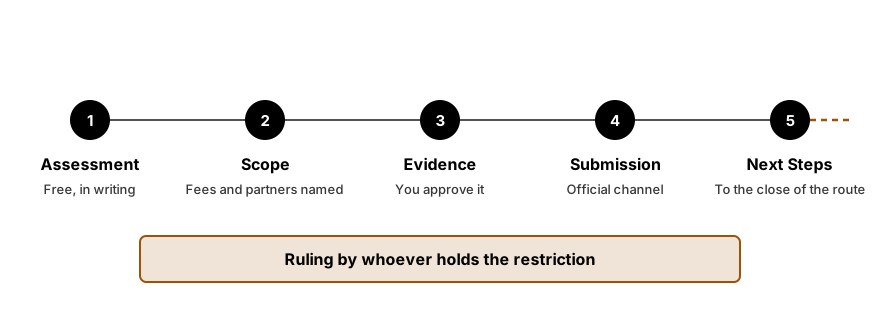
Inputs to prepare
- Death certificate, or medical documentation of incapacity where that applies
- Evidence of legal authority: a court order, a will, letters of administration, or a power of attorney
- Government-issued photo ID plus proof of address
- Evidence of your link to the person, if a platform requests it
- Input records including emails, bank statements, and devices that reference specific exchanges or wallets.
- Any account names, email addresses, or phone numbers known to be used for crypto
- Inventory every device, hardware wallet, wallet file and paper note you locate.
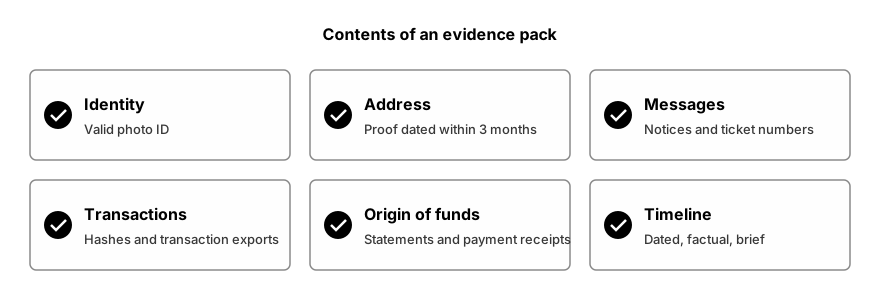
What we cannot do
- We cannot compel an exchange to release an account, and we do not guarantee any crypto will be found. Some assets stay unreachable without keys.
- We do not hack accounts, guess passwords or bypass security controls. Access happens only through lawful routes and the platform's own process.
- Independent licensed counsel dictates legal advice, which varies by jurisdiction; this guidance is provided externally.
- No request for seed phrases, private keys, or passwords will be made for any account, whether yours or the deceased's.
Common situations
- Deceased relative had an exchange account; the password is unknown
- Hardware wallet located in belongings, with neither PIN nor seed phrase
- Email or bank traces pointing to crypto purchases, but no wallet inventory
- Exchange that will not deal with family unless a court order or grant exists
- Relative who handled crypto alone, now with dementia or after a stroke
- Encrypted wallet file stored on an aging computer within the estate
This fits your case if
- A relative died and may have held crypto, with no records of where
- An exchange account exists, but the platform demands documents you cannot provide
- A family member lost capacity, and lawful access to their assets is needed
- You act as executor or administrator and need a digital asset plan
How long it takes
Estate and incapacity cases run on legal timelines and platform queues; expect months. Asset searches may finish faster than an exchange release. We state an estimate after the assessment and revise it as the case moves.
Fees
The initial assessment costs nothing. Independent lawyers and independent specialists bill at rates they set themselves; some technical work in this area runs on a success-based model, though the exact terms differ case by case. Each fee is documented in writing before any work begins, and no payment is requested before we state whether we can take the case. Fees →
Questions people ask
How do I gain access to a deceased person's crypto?
Lead with the law and the paperwork. You typically need proof of death plus proof of your authority; then you apply to each exchange through its own process. For self-held wallets, you need the keys or a lawful technical route.
If the physical location of the cryptocurrency remains undefined, what determines the operational procedure?
Start with evidence gathering: emails from exchanges, bank transfers to crypto firms, apps installed on phones, hardware devices, and handwritten notes. Locating a list of platforms is frequently the first concrete step. Some assets may remain undiscovered.
Will an exchange communicate with me as a relative?
Usually only once legal documents are supplied. Many exchanges operate a deceased-account process requiring a death certificate and proof of your authority. Absent these, privacy rules typically prevent them from disclosing details.
Can the wallet be opened without the password?
Not through hacking. Where a wallet file or device belongs to the estate, independent specialists may attempt lawful recovery, but the outcome is not assured. If both keys and password are gone, access may be impossible.
Is a lawyer required for this?
In most cases, yes. Deciding who holds authority over an estate, or over a person who cannot act, falls under law, and each country sets its own rules. A licensed independent lawyer confirms which documents apply to your situation. We handle the coordination after that.
How can I shield my own family from this situation?
Maintain a secure record of where your crypto sits and inform a trusted person how to locate it, without storing seed phrases in plain notes. Consider legal advice on a will or power of attorney covering digital assets.
Related situations
- Recovering wallet passwords and damaged files. Lost password or damaged wallet file: screened independent specialists attempt recovery.
- Hardware wallet recovery assistance. Lost PIN, damaged or missing hardware wallet: honest options plus vetted independent labs.
- Sourcing of funds and wealth: document packs. Build a clear source of funds and source of wealth pack for exchanges, banks and processors.
- Unblocking a restricted exchange account. Read the freeze, build KYC and AML evidence, answer compliance, appeal.
Read next
The content on this page is general. It is not legal advice.