
A wallet or deposit got a high-risk flag: how to build the record and file a challenge
Status: Published: Last reviewed: Editorial policy
Address screening tools assign each wallet a score based on links to risky services: mixers, darknet markets, sanctioned entities. The score controls the outcome: a high one can freeze a deposit even if your own conduct was clean, because the risky link can sit several hops away in the fund path. A flag may also be wrong or stale. We trace the actual path of your funds, assemble the record, and submit the challenge to the exchange. We do not help hide illicit funds.
Need a case detail checked? Send it here:
What we do
- Read what the flag states
Step one: request the exposure category and the screening vendor from the exchange. Step two: read that vendor's scoring rules. A direct link to a flagged service carries far more weight than indirect exposure spread across many hops.
- Follow the actual route your funds took
Analysts who do not work for us trace each transaction in two directions: backward from your wallet to the origin, and forward to the flagged entity. The output classifies the exposure as direct, indirect, small in amount, or not linked to anything you did.
- State your position in plain language
Record the origin of the funds first. State the counterparty, the purpose and the date for each acquisition. Then attach purchase records, chat logs and receipts. A compliance reviewer checks a consistent, dated account; scattered claims fail that check.
- Contest the flag with the exchange
Prepare a structured dispute: it names the flagged transactions, states whether the exposure is indirect or the match is mistaken, and requests a defined review. The tone stays factual. Submit it through the exchange's official channel only.
- Report errors to the analytics vendor
If the underlying data looks wrong, for example a stale label or a cluster attributed to the wrong address, submit a correction request to the screening vendor. The route is usually the exchange, or the vendor's own dispute form.
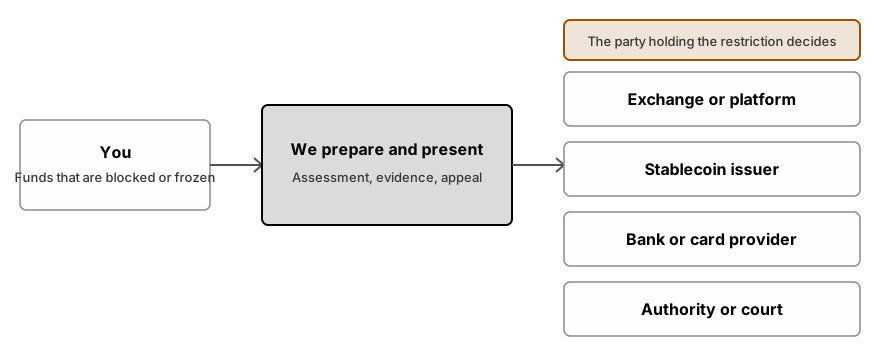
How a case runs
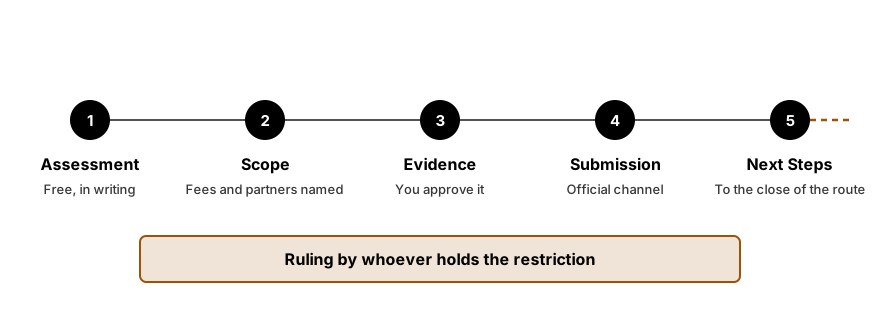
- Free initial review
Input: the flag notice and what you were told was flagged. Output: a written reply stating whether this reads as a false positive, indirect exposure or a harder category, and whether the service can assist.
- Scope and fee, confirmed in writing
If the service proceeds, you receive a written scope, the names of the independent analysts involved and the fee model. No payment is due before you have read that scope and accepted it.
- Transaction screening
Independent analysts examine each flagged transaction and map the transfer path. The output is a plain-language summary: what the blockchain record shows, and what it does not show.
- File the dispute
The service sends the dispute and the evidence pack to the exchange. If a vendor applies, the service also sends a correction request to that vendor. Copies and reference numbers are provided to you as output.
- Aftermath: outputs and the next actions
We monitor responses, address follow-up queries, and state directly whether the flag has a valid basis or whether no resolution path exists.
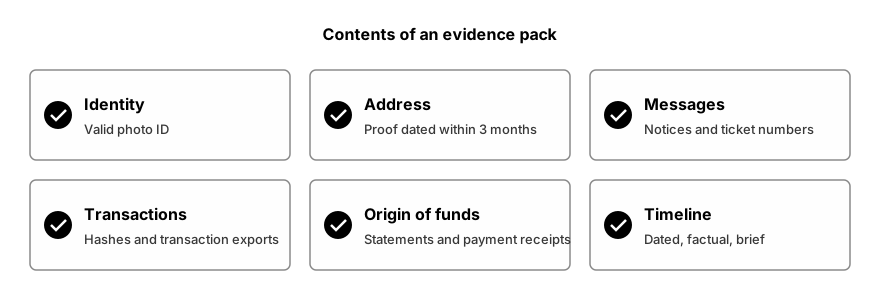
Inputs to prepare
- The notice or email from the exchange that states the risk flag
- Wallet addresses and transaction hashes that are part of the dispute
- Documents showing where the funds came from: receipts, invoices, chat logs, or bank transfer records
- Identity of the counterparty, where known, together with any contract or order
- Screenshots of any risk-check result from a third-party tool
- Submit government-issued identification and a document confirming your residence address only when the exchange demands these items.
- Submit a concise chronological record of the transfer sequence and the initial alert trigger.
What we cannot do
- No one on our side can force an exchange or a screening vendor to remove a flag. That control sits with them: they decide under their own policies and under the law that applies to them.
- The service does not hide, clean or mix illicit funds. If evidence indicates the funds come from crime, we do not take the case.
- If the analysis supports the flag, we state that directly; we do not promise any outcome.
- Never send us a seed phrase, private key or exchange password. We will not request them.
Common situations
- Deposit arrives on the books, then a screening alert on the address puts it on hold
- Funds received from a peer-to-peer trade whose sender wallet touched a mixer years ago
- Systems generate sanctioned exposure flags when an account accepts an unrequested, minor initial transfer.
- Exchange gives only a high risk score and will not state the exact trigger
- Withdrawal blocked because an earlier deposit touched a flagged cluster
- Business wallet gets a flag after a customer pays from a risky address
This fits your case if
- An exchange held or rejected your deposit and quoted a high risk score
- You got crypto from a peer or a shop and later learned it had indirect exposure to a mixer or darknet
- A free checking tool shows a risk label on your own wallet and the reason is unclear
- A compliance team queries a counterparty you know barely
How long it takes
Two variables control the timeline: the exchange's compliance queue and the volume of transactions requiring tracing. A short single-path case resolves sooner. Output is an estimate after assessment, revised as replies arrive.
Fees
No charge applies to the assessment. Once that check is done, you get a written scope plus the fee model for your case. We ask for payment only after stating whether we can take the matter on. Fees →
Questions people ask
What is a high-risk wallet flag?
A screening tool has produced a match: the address connects to a category like a mixer, a darknet market or a sanctioned entity, either directly or through several intermediate hops. Treat the flag as a trigger for human review, not as evidence that you did anything wrong.
Can a flag be a false positive?
Yes. Three failure modes exist: outdated labels, misattributed clusters, and small indirect exposure inflating a score. That is why a review at transaction level matters. Whether the tool or the exchange accepts the correction is not under our control; what we can control is presenting the record clearly.
Does this service remove risk flags associated with a specific wallet?
Flag control resides with the exchange and vendor. We cannot remove the flag, but we document potential reasons for error and submit a structured dispute request through the proper channel.
Will services assist if the funds originated from a darknet market or a mixer?
We do not provide assistance in concealing or laundering illicit funds. If review output indicates a verifiable link, we will inform you. We may coordinate truthful responses for lawful compliance requests utilizing an independent attorney.
What actions should not be taken once a deposit has received a risk flag?
Never transfer the funds across separate wallets or services to evade the review. Such actions may be interpreted as evasion, which compounds the current compliance constraint. Maintain fund static status, preserve all records, and input truthful data into exchange inquiries.
Is a free risk checker output sufficient evidence to verify wallet cleanliness?
External free checkers utilize different data sets and scoring algorithms than the exchange's specific mechanism. A favorable outcome from such checkers cannot nullify the exchange's tool result. This output remains usable as an additional data point when formulating a dispute.
Related situations
- Sanctions and AML false positives: support. Wrong sanctions or AML match: evidence pack plus a lawyer-filed statement to clear the flag.
- Blockchain analysis report. A source-of-funds report built by tracing transactions, formatted for a compliance team.
- Unblocking a restricted exchange account. Read the freeze, build KYC and AML evidence, answer compliance, appeal.
- Diagnosing a crypto freeze. Identify the party behind a freeze and the realistic next step.
Read next
The content on this page is general. It is not legal advice.