
Recover a Crypto Wallet Without the Seed Phrase: What Works and What Does Not
Status: Published: Last reviewed: Editorial policy
Rarely possible. In self-custody, the seed phrase acts as the master secret, and the wallet vendor stores no duplicate. Recovery remains feasible only if one residual control exists: a device still unlocked, an encrypted backup file plus its password, most of the seed words, or a custodial account you can verify. Absent all four, no party can rebuild access, us included. Never transmit your phrase to anyone who approaches you offering assistance.
Need a case detail checked? Send it here:
Straight answer: a seed phrase that is lost cannot be reconstructed
A seed phrase, also called a recovery phrase, is a word list, usually 12 or 24 words, that encodes the wallet's master secret. In most modern wallets, every address and key derives from it. Control of the words equals control of the funds.
Funds reside on the public blockchain instead of the local application instance. The seed phrase serves as the verifiable evidence for initiating transactions. Self-custody creation processes generate the phrase locally without server storage. External systems cannot retrieve this data and no entity can execute a reset.
The space of possible phrases is far too large to guess, even with powerful hardware. Any service claiming it can guess your full phrase is not telling the truth. The useful question is different: which other input do you still hold?
What you may still hold, and where it can lead
Do not assume the funds are lost until you inventory what still exists. A seed phrase is one secret among several. Some other secrets can grant the same access. The table maps common situations to the realistic outcome of each.
| What remains in your possession | Access that may still be possible | Who performs the work |
|---|---|---|
| A wallet app or hardware device that remains unlocked | In many cases you can move the funds to a new wallet, or the settings may display the recovery phrase, depending on the wallet | You, following the maker's official instructions |
| A hardware wallet with its PIN, but no written phrase | Typically the funds can still be moved to a new wallet, after which a proper backup can be set up | You |
| A hardware wallet with a forgotten PIN and no phrase | Options are narrow: devices are engineered to resist guessing, and many wipe their contents after repeated wrong PIN entries | The maker's official support channel, or in a small number of cases an independent lab |
| An encrypted wallet file exists, but the password does not | If parts of the password are remembered, specialists can run likely variants against a copy of the file. If it is fully forgotten and strong, no route exists | An independent specialist, working only on a copy |
| Most of the recovery words are known; one or two are missing or unclear | A specialist can sometimes reconstruct the phrase by testing candidate words against an address you already know. The odds drop sharply with every missing word | An independent specialist, working offline, under a written agreement |
| A custodial balance on an exchange or app where the login is lost | Account recovery through the provider, which typically requires you to prove your identity | The service. We help you get the paperwork ready |
| Zero inputs: no hardware, no backup file, no phrase, no login | No route exists. The coins stay on the blockchain, but no one can move them | No one |
If a wallet or device still opens
Access is the control here. A wallet left unlocked on a phone, computer or hardware device can usually still send funds even if the written phrase is lost. If it opens, your first task is to move the coins to a new wallet, then write down and store its phrase with care.
Several software wallets can display the recovery phrase again in the security settings once you confirm with your password or PIN. Check that location first. Take the exact steps from the wallet maker's official help page, and reach it by typing the address, never through an ad or a message.
Most hardware wallets hide the phrase once setup is done, yet a correct PIN still allows signing. Use the device to transfer the funds, then create a new backup. Do not keep guessing a PIN you have lost: many devices wipe themselves after a few failed attempts.
Encrypted files, partial phrases and forgotten passwords
The wallet file retains encrypted cryptographic keys within its structure. If the password is unknown, a specialist tests probabilistic inputs against a copy. Recovery depends upon remembering specific partial input patterns. Highly random, fully forgotten credentials yield no outcome.
A phrase with one or two words missing or unclear can sometimes be completed by testing candidate words against an address you control. Workload rises sharply per missing word. Expect slow, technical, offline effort by experienced people; never a website. Recovery words are never taken by us. If you proceed, hand the words only to a specialist you vetted, under a written agreement.
- Operate on a copy of the file. Store the original unchanged somewhere safe.
- Never enter recovery words into any site offering to check, repair or fill them in.
- Fix scope and fees in writing before work begins.
- Keep funds in your own control. Any helper demanding you send coins first is running a scam.
Custodial accounts and vendor recovery paths
If your coins sat on an exchange or in an app that holds them for you, you likely never held a seed phrase. The provider controls the keys; you control a login. A lost login follows the provider's own account recovery, which normally requires identity proof. Run the official process in the app or on the site, and plan for delays.
Certain wallets differ by design. Smart-contract wallets, shared-key wallets, and wallets using guardians or encrypted cloud backups each have distinct recovery routes. The applicable route depends on your original setup. Read the maker's official help page, and search your cloud account, email and password manager for any backup you overlooked.
If the wallet belonged to a person who has died, a separate route applies. It proceeds through legal documents and the exchange's own process for deceased customers, as covered on our inheritance and lost access page.
Recovery scams targeting people without a phrase
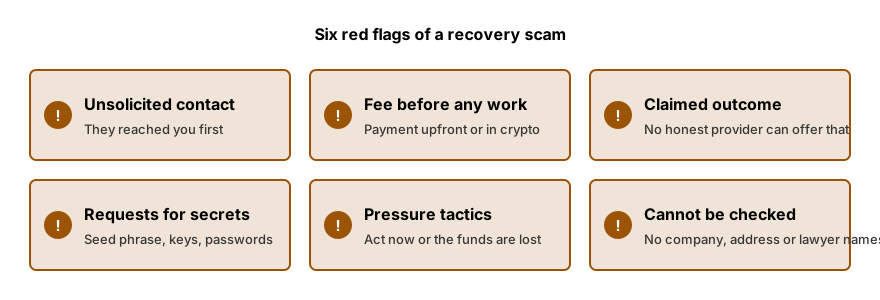
Publicly posting that a wallet is lost triggers scammers within hours. They answer threads, send direct messages, buy ads and clone genuine wallet websites. The target is your recovery words, your password, or a fee paid in advance. If an incoming message matches any entry in the list below, stop all replies.
- An unknown person who contacts you first and claims they can recover the wallet.
- Any form, app, or 'validation' page requesting your recovery words as input.
- A payment requested before any review of your situation, or a cryptocurrency payment directed to an individual wallet address.
- A claim of certain success, or a supposed special tool that can open any wallet.
- Any instruction to set up software that lets another party control your computer remotely.
A reasonable next step
Build a written inventory of what you still hold: devices, files, backups, account logins, old computers, notes, and approximate dates. Compare every entry against the table above. A forgotten backup often surfaces at this check.
If you hold a wallet file, a partial phrase, or a hardware wallet that refuses to open, request a free assessment from us. We state in writing whether any route looks realistic. If a route exists, we coordinate independent specialists and describe how they operate. We cannot produce access that does not exist, and we never request your seed phrase, private keys, or passwords.
Frequently asked questions
If I lose my seed phrase, can wallet support retrieve or reset it for me?
No. Control over a self-custody wallet sits entirely with the phrase, and the maker has no record of it, so no reset or retrieval path exists. Support can only explain how the app works. Any message offering to restore the phrase for you is a scam.
I know my wallet addresses but not the phrase. Is that useful?
Addresses are public records. They show a balance, but holding one gives no control over funds. Moving funds requires the keys behind the address. Addresses are still useful input: a specialist can use them to test a partial phrase or to confirm that a recovered wallet is the correct one.
Could a specialist work out my complete seed phrase?
No. A complete 12 or 24 word phrase has far too many possible combinations to guess. Work is possible only in narrow cases: when most of the words are already known, or when a wallet file exists and part of its password is remembered.
Is a wallet recovery tool downloaded from the internet safe?
Treat such tools as a risk, not a help. Many are built to steal the phrase typed into them. Use only software linked from the wallet maker's own website. Never enter recovery words on a page reached through an ad or a message.
Do my coins vanish if I wait?
No. A blockchain balance neither shrinks nor expires while the search continues. The actual risks run the other way: backups get lost over time, and someone else may find the phrase first. Start the backup search now, and store anything found with care.
How we can help
- Recovering wallet passwords and damaged files. Lost password or damaged wallet file: screened independent specialists attempt recovery.
- Hardware wallet recovery assistance. Lost PIN, damaged or missing hardware wallet: honest options plus vetted independent labs.
- Crypto access after death or lost control. Lawful access to crypto of a deceased or incapacitated person, via lawyers and specialists.
The content on this page is general. It is not legal advice.