
Sharing files with a crypto recovery service: what to send, what to hold back
Status: Published: Last reviewed: Editorial policy
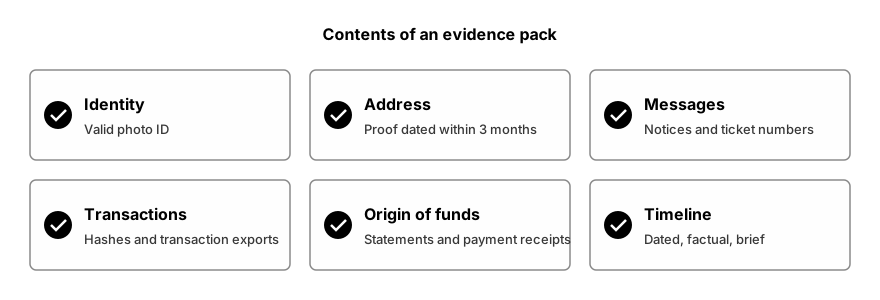
Release documents in stages. For an initial assessment, a brief written account plus public data like transaction hashes, wallet addresses and dates is sufficient. Statements and identity documents go out only after the counterparty is verified and a written scope is agreed. Do not disclose a seed phrase, a private key, a password, a one-time code or remote control of your device, regardless of who asks or what justification is given.
Need a case detail checked? Send it here:
Share in stages, not everything at once
When crypto access is lost, several parties may request paperwork: exchanges, banks, police, lawyers and recovery services. Fraudsters are aware of this pattern. A portion of fake services exists for one purpose: harvesting identity papers, wallet access or both.
A legitimate provider needs facts about your incident, not the secrets that control your wallet. Share information in stages, and verify each party before each stage. If you follow that sequence, a real provider still gets everything it needs, while a fraudulent one receives almost nothing.
| Stage | What you may send | Condition |
|---|---|---|
| 1. First assessment | A brief written summary, platform names, dates, amounts, transaction hashes and public addresses of wallets | A basic existence check on the party. Identity documents are typically not required at this stage. |
| 2. After a written scope is agreed | Redacted statements, chat logs, screenshots, notices and the police report number | The party is verified, and you have read the scope, the fee model and who will access the files. |
| 3. When a filing requires it | ID and address records, documents showing you hold the funds, and forms you have signed | Three things must exist: a named recipient, a stated purpose, a secure channel. Where the platform or authority itself requires identity papers, hand those papers to it directly. |
| Never, at any point | Mnemonic seed phrases, private cryptographic keys, authentication passwords, one-time codes, and remote software access permissions. | No justification makes this safe. Any such request signals a warning. |
What must never be shared
These items convey control, not data. Whoever has them can move your funds or seize your accounts. No honest review, trace or filing requires them; a request for any one of them is a warning sign.
- Your seed phrase or recovery phrase, including any photograph of it.
- Private keys, including exported key files and keys stored within a wallet app.
- Passwords and PINs covering wallets, exchanges, email, banking and your phone.
- One-time codes, authenticator codes and backup codes.
- Do not grant remote control of your computer or phone, including any screen-sharing session.
- Do not submit API keys that permit trading or withdrawal, or full card numbers paired with the security code.
- A screenshot or scan of any item above is also accepted. Inspect every image first: a corner of the screen may show a code or a phrase.
Redact documents before sending
Redaction is the suppression of data that is not required for the subsequent step. This action constrains potential damage in the event of a file leak. Ensure proper redaction, because a black box over editable PDF text permits the underlying data to be copied.
Redact visible text before sharing. One method: use a tool that deletes the text layer. Another method: print the page to a new PDF and send that output. A third method: take a screenshot of the redacted result and send that image. Also strip hidden file metadata. Photos and documents often contain embedded data: dates, device names and location coordinates.
- Redact every input the request does not require: ID numbers, full card numbers, statement transactions unrelated to the case, and names of people outside the case.
- Display your name, relevant account or wallet identifiers, dates, amounts, and lines that serve as evidence.
- Mark the copy as redacted and retain the unredacted original. Alter no number and no date.
- Input visible identifiers onto identity copies, specifically the recipient name and the current date. This action constrains the document's utility, thereby impeding subsequent reuse of the provided evidence.
- When a platform, a police unit or a court requests unredacted files, deliver those files to that body yourself if possible.
Pick a secure file delivery method
Send files through the channel that the other party names, and confirm that the channel name came from a trusted source, for example their website typed in by hand, not a link inside a message. Skip social media chats, public group chats and open share links.
- Use a portal on a site you opened yourself, or a messaging or email channel that encrypts end to end.
- If you share a folder link, add an expiry and a password, and disable public access.
- Encrypt the archive with a strong password, then send that password over a separate channel, for example a call you place yourself.
- Never send from a device you suspect is infected, and avoid public Wi-Fi during the send.
- Record what you sent, when, to whom and by which method.
- Request in writing how long the party retains your files and how deletion happens after the case.
Confirm the identity of the other party
Run the checks before you pass anything beyond stage one to a counterpart. A legitimate firm welcomes that scrutiny and replies in writing. For a longer screening checklist, see our guide on identifying recovery scams; the same list applies to this service.
- Ensure the entity's full legal name, registration number, and official address are confirmed in the national corporate register.
- Determine which personnel access the documents: staff, independent lawyers, or independent specialists. Mandate request for specific names and stated roles.
- Self-verify the lawyer's licensing status by cross-referencing the official bar or legal register directly. Avoid accepting verification via supplied links.
- Ascertain if the entity initiated contact. Receiving unsolicited communication subsequent to a loss constitutes a risk indicator.
- Evaluate if the service requests capital, account access, or confidential information before detailing the proposed actions.
What a reasonable confidentiality commitment contains
Vague statements regarding data safety hold no value. A viable promise must be explicit, documented, and transparent about limitations. It must specify coverage, viewing personnel, intended use, retention period, and the mechanism for deletion.
Our written scope defines document visibility, requiring your approval for every transmitted item. Obtain written verification from any prospective provider detailing this procedure.
| Item Number | What a fair commitment states | What signals a problem |
|---|---|---|
| What falls within scope | Every record and detail you supply, in whatever format | A commitment limited to 'sensitive' items, with no definition given |
| Who is allowed access | Named personnel and named independent partners who require it, each bound in writing | 'Trusted third parties' listed without names or roles |
| Purpose of use | Applied solely to evaluate and process your case | Used for marketing, data sales or files of other clients |
| Storage and deletion | Written retention period plus deletion on request, unless law requires keeping the files | No stated retention terms, or refusal to delete |
| Disclosure | Given to authorities only when law requires it; you are told where the law allows | A promise of total secrecy that no one can keep |
| Approval | You approve which documents go to each recipient | Documents forwarded without your approval |
Procedures for Document Disclosure Errors
Errors occur during data input transmission; these instances can be addressed. Document the sequence of events and timestamps. If evidence organization assistance is required, request a free assessment. We provide written notification regarding potential aid and never require sensitive credentials.
- If a seed phrase or private key was shared, treat the wallet control as compromised. Transfer remaining funds to a newly created wallet using an isolated device.
- Upon shared access codes, immediately change the authentication password. Terminate all active sessions and replace the current two-factor authorization mechanism.
- If remote system access is granted, disconnect the device. Remove the software tool, execute a security scan, and update authentication credentials from an alternate machine.
- Identity documentation submitted to an unverified third party requires informing your bank. Obtain fraud alerts or initiate credit monitoring services specific to your jurisdiction.
- Report the event to local police or the national cybercrime division. Document the case reference provided by the receiving agency.
Frequently asked questions
Does identity verification via passport transmission occur when requesting a free assessment?
Initial review depends on input data rather than primary identification. A written description along with public data like transaction hashes, addresses, and timestamps suffices for the initial evaluation. Identity records are only required later if the dependency is triggered by a formal legal filing. These documents are safer when submitted directly to the requesting platform or authority.
Is the transmission of exchange account screenshots secure or recommended?
Yes, but inspect every screenshot before you send it. Confirm that no one-time code, API key, recovery phrase or complete card number is visible, and mask anything the next step does not require. Store the original files: a reviewer may request them at a later point.
A recovery service wants to connect to my computer to inspect my wallet. Should I permit it?
No. Remote access hands the other party control over your device, your accounts and every window open on screen. A legitimate assessment, trace or filing requires none of that. Treat the request as a scam and stop all contact.
For what period is a recovery service supposed to retain my documents?
No single rule exists, and some jurisdictions set retention periods by law. Request the period in writing, plus the deletion procedure applied when the case closes. A provider that cannot state both is not fit to hold your data.
Can a provider commit to keeping my documents unseen by any other party?
No honest provider can make that commitment. Work may require passing files to named lawyers or specialists, and courts or authorities can compel disclosure. A fair promise states those constraints and asks for your approval before any file moves.
How we can help
- Digital evidence prep for crypto cases. Collect chats, screenshots and records, log each item, arrange them for use by police, platforms or lawyers.
- Support after a crypto scam. Structured help after a crypto scam: assess, document, trace, request freezes.
- Recovering wallet passwords and damaged files. Lost password or damaged wallet file: screened independent specialists attempt recovery.
- Tracing stolen crypto, sending freeze requests. Tracing, freeze requests to exchanges and issuers, and police report support.
The content on this page is general. It is not legal advice.