
Digital evidence in a crypto case: capture it, label it and organise it for police, exchanges or court
Status: Published: Last reviewed: Editorial policy
Strong digital evidence has four properties: it is captured early, it is never altered, it is labelled with collector, time and method, and it is ordered so a stranger can follow the trail. Our role is to help you gather and index chats, screenshots, statements and transaction records, and to coordinate independent forensic specialists when a formal capture is required. No court, police unit or platform is obliged to accept the evidence; we cannot promise acceptance.
Need a case detail checked? Send it here:
What we do
- Flag what to preserve and what to leave alone
The written checklist mandates strict operational constraints. Do not delete communications, reset devices, or edit source files. Copies permit presentation modification; originals must remain unaltered.
- Record each item and log the capture
For every item, log five fields: what it is, its origin, who captured it, the date and time, and the method used. This record is often the check that turns a screenshot into evidence a reviewer can trust rather than just an image.
- Set up formal capture through independent specialists
If content may vanish or be contested, independent digital forensic specialists can capture web pages, accounts or devices using documented methods and log file hashes. Our part: brief them, fix the scope with them, and review their output.
- Build the evidence pack
The pack is an indexed bundle with four parts: a timeline, numbered exhibits, a transaction table and a short cover note. Translated or redacted material is labelled as such, and originals stay retrievable.
- Match the pack to its reader
Each recipient expects its own format: a police unit, an exchange compliance desk and a court do not read the same way. We tailor the pack to whoever receives it, cross-check names, dates and amounts for consistency, then release the final version to you or to your lawyer.
How a case runs
- Free initial review
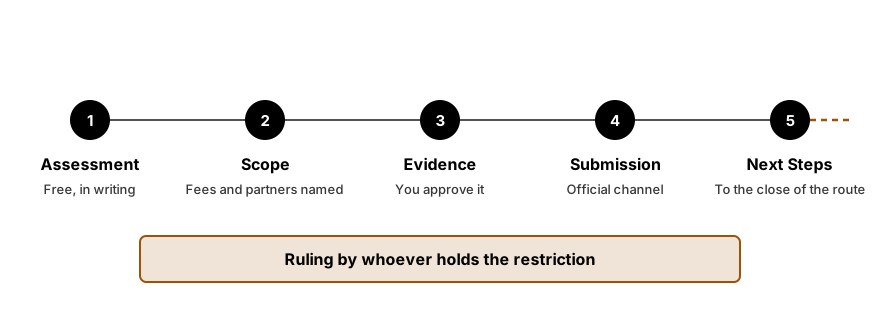
You state the case and what you hold. We reply in writing: which items matter most, which risk disappearing, and whether a formal capture looks worthwhile.
- Scope in writing, plus fee
If you go ahead, you get the scope, the specialists involved and the fee model in writing. Any forensic capture appears as a separately quoted item.
- Gathering and recording evidence
Transmit each item over a secure channel, or capture it using our checklist. We log every item and mark gaps, duplicates and conflicting entries.
- Formal capture, when required
Where capture is needed, independent specialists record the relevant pages, accounts or devices and produce a method log plus hashes. We check their output against your stated scope.
- Handoff
The output is an indexed pack with a log and a brief submission guide. We assist with sending it and handle questions from the recipient.
Inputs to prepare
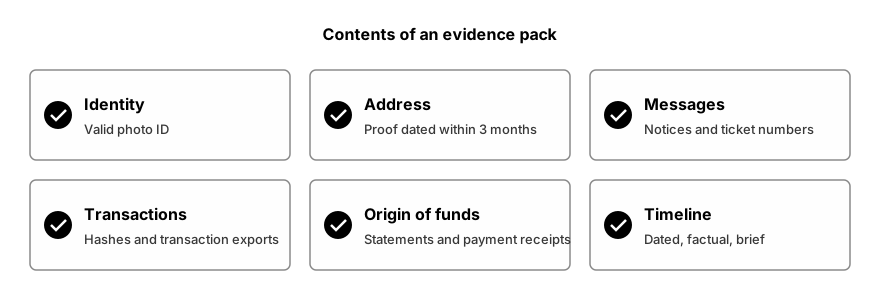
- Original files: photos, PDFs, emails and chat exports, not just screenshots of these
- Device and app data: model, app names, usernames and phone numbers in use
- Web addresses for the scam site, the profiles and any visited pages
- Exchange, wallet and bank statements showing visible dates
- Transaction hashes plus wallet addresses
- Numbers from police reports and ticket references from platform support
- A timeline you write yourself
- Provide translations or explanatory notes for material not matching the procedural language.
What we cannot do
- The system cannot mandate acceptance of evidence by courts, exchanges, or legal units. Admissibility and evidentiary value are dependent on jurisdiction policy.
- Independent forensic specialists execute formal data captures and attest to their own findings. TraceStolenCrypto does not conduct or sign these technical reports.
- TraceStolenCrypto does not generate, modify, date, or improve evidence. If an item exhibits damage or absence, we document this specific constraint.
- Legal advice is outside our scope: we do not practise law, so your lawyer decides what must be disclosed and in what form.
- We never ask for seed phrases, private keys or passwords, and remote access to your device is not needed.
Common situations
- Phone gallery screenshots stored without dates, order or context
- A messenger chat with the scammer: deletable at any moment, or lost if the account gets banned
- A fake investment site that displays your balance and can stop serving pages at any time
- Exchange statements in mixed formats and languages, with missing dates between records
- Platform emails where the headers and attachments carry evidence value
- A device that someone else could reach remotely, and that now requires careful handling
- Documents written in another language, needing a translation your lawyer can rely on
This fits your case if
- When initiating a police report, we organize data elements such as chat records and evidence screenshots.
- For an appeal directed at an exchange or bank, we prepare an indexed compilation of relevant evidence.
- Your lawyer has asked for original files plus a record of how each one was collected
- If a scam website, profile, or chat can vanish, save it with correct procedures before it is lost.
- Critical messages stay stored on a phone or laptop that must not be harmed during collection
How long it takes
Intake begins upon submission of initial materials. While compilation usually requires days, formal capture depends on specialist availability and scope. Time estimates are issued following the initial assessment.
Fees
The initial evaluation is provided without cost. Costs for compiling the package and contracting specialists are provided as separate, itemized quotes, ensuring payment only for selected actions. No fee is levied prior to determining service viability. Fees →
Questions people ask
Does a screenshot meet the evidentiary standard?
A screenshot has some value, but a counterparty can challenge it easily. Preserve these inputs together: the original file, its date, the page address, and the identity of the person who captured it. Export the complete chat log as well. If the content is critical, then a formal capture performed by an independent specialist carries more evidential weight.
Should the app be removed or the phone reset before evidence collection?
No. Keep the device in its current state until you know which data is required. Uninstalling apps, doing a factory reset, or running cleanup tools can destroy records. If someone else may still control the device, report this to us before any change.
What does chain of custody mean?
A chain of custody is a record showing who held an item, at which time, and what was done to it, starting at collection. Its function is simple: if the record is complete, then the item can be shown to match its state at capture. The required checks and the detail expected depend on the jurisdiction; the rules are not uniform.
Will you archive a fraudulent website on my behalf?
Here is the mechanism: an independent specialist performs the capture. The output is a documented set of pages, each stamped with the date, the address and file hashes. Do this step early. The dependency is external: scam sites vanish without notice, and a capture that arrives after removal cannot be made. State the constraint plainly: we cannot promise that any capture will be accepted as proof.
Is phone or account access required?
No. Collection is done by you, following our checklist, or by an independent specialist who acts only with your explicit permission and inside a written scope. We never request passwords, seed phrases or remote access.
What separates evidence preparation from an expert report?
Evidence preparation collects, preserves, and organizes material. An expert report independently analyzes that material, for example tracing fund movement. Many cases require both steps. The first step enables the second.
Related situations
- Expert reports for court use. We coordinate the report and prepare exhibits. Independent experts write the content. We check clarity.
- Blockchain analysis report. A source-of-funds report built by tracing transactions, formatted for a compliance team.
- Support after a crypto scam. Structured help after a crypto scam: assess, document, trace, request freezes.
- Tracing stolen crypto, sending freeze requests. Tracing, freeze requests to exchanges and issuers, and police report support.
Read next
Sources
This record is derived from external, primary sources. Validation depends on the source documentation. Changes occur; review the originating platform for current content.
The content on this page is general. It is not legal advice.