
After a crypto scam (investment, romance, fake platform): the options that exist
Status: Published: Last reviewed: Editorial policy
Verdict: funds lost to a scam come back only in some cases, and nobody can promise it. The result depends on where the money went and whether an exchange or issuer can freeze it. We help in sequence: save evidence, report the scam, trace the funds with independent specialists, send freeze requests. In most places, reports to the authorities cost nothing.
Need a case detail checked? Send it here:
What we do
- Take the account of events first
The starting input is your own account: what happened, and what has been sent or shared so far. Shame after a scam is common and is no reason for silence. Known facts are separated from open questions.
- Contain further loss; secure accounts
Pause immediately: further payments, shared access, and any app you were told to install. We guide you through changing passwords and moving what remains into a new wallet, which you do yourself. Access is never handed to us.
- Build a dated record
The record holds a timeline, transaction hashes, wallet addresses, screenshots of chats, ads and sites, and bank records per payment. An orderly file makes a police report or platform request much easier to process.
- Trace the transfers with independent analysts
Independent blockchain analysts follow the transfers from your payment to the last point of movement, whether that is a deposit address at an exchange or a stablecoin address. The written summary says exactly where the trail ends.
- File reports and send freeze requests
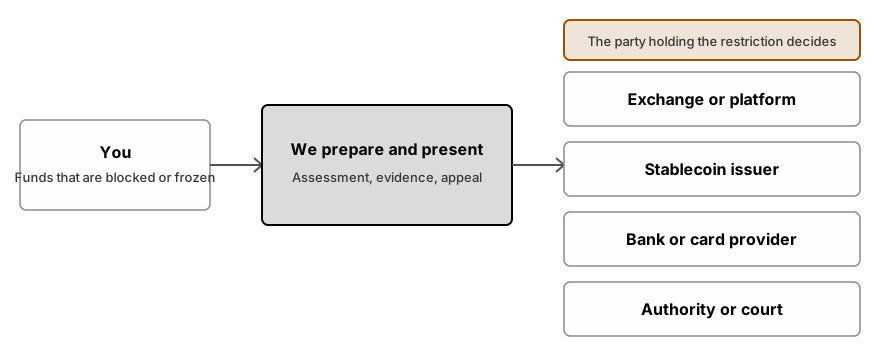
If the trace reaches a platform able to act, a structured freeze request with evidence goes to it. Reports are filed with the police and with the site where contact began. Each recipient makes its own decision.
- Vet recovery offers; plan what follows
Any offer to recover your funds is reviewed with you and its warning signs are marked. We also state whether a lawyer, a regulator complaint or a civil claim is sensible, or whether the case has run its course.
How a case runs
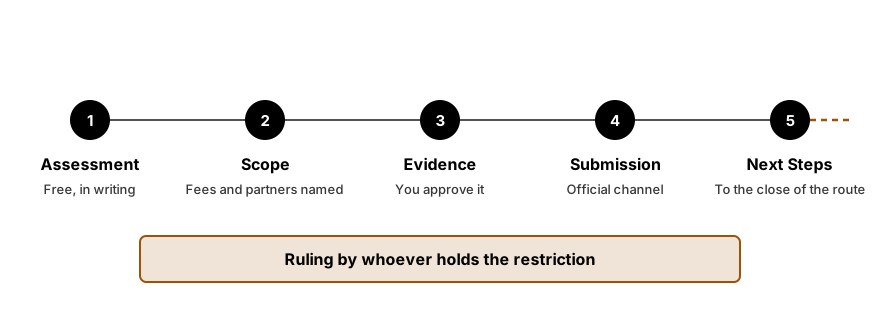
- Assessment, free
Input: your account and what you hold. Output: a written, honest view of what is realistic. No charge, no obligation, and you may stop at any point.
- Scope and fee
If we can help, a written scope, the independent specialists and the fee model are sent to you. Take as long as needed to read them. A deadline is never used to press you into paying.
- Evidence, then tracing
Documents arrive through a secure channel and are checked for gaps. Analysts trace the transfers and write the findings in plain language.
- Reports and freeze requests
The police report is filed with your help, and freeze requests go to every platform the trace identified. You get copies and each reference number.
- Tracking and closure
Replies are tracked and your questions answered. When a route is exhausted, that is stated clearly. The case closes with a short written summary of what was tried.
Inputs to prepare
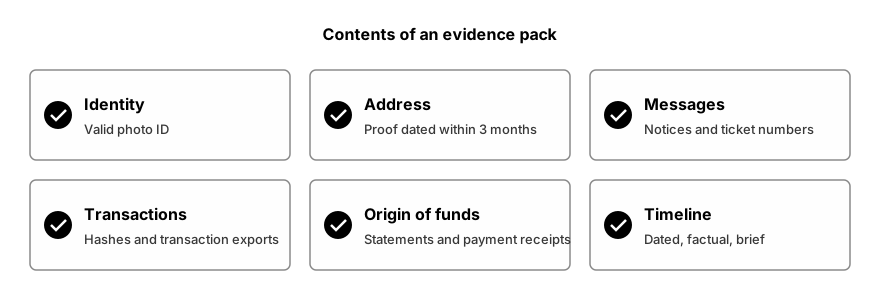
- Hashes and wallet addresses for each payment made
- Screenshots of the site, app, ads, profiles and the complete chat history with the other party
- Bank, card and exchange statements covering the payments behind the transfers
- Any names, usernames, phone numbers, email and web addresses the scammer used
- Contracts, invoices, balance screenshots or fee demands you were sent
- Earlier reports, each with its reference number
- A brief timeline in your own words, from first contact to final payment
What we cannot do
- No exchange, issuer or police force can be forced by us to act. Each decides under its own rules and applicable law.
- Nobody can promise to bring scammed funds back, and neither do we. A frequent outcome is a clean record of events without any recovery.
- Funds that reached a private wallet or passed through a mixer usually cannot be frozen. If the trail ends there, we say so.
- Hacking wallets, negotiating with scammers and paying anyone to release funds are outside our work. An offer to do any of these is a scam.
- A seed phrase, private keys or passwords are never requested, and neither is remote access to your device.
Common situations
- The trading app reports a large profit, yet wants more money before any withdrawal is released
- Someone never met in person asked you to move savings into crypto jointly
- Money went from the bank to an exchange, then onward to an address the other person supplied
- A fake support agent requested installation of a screen sharing app
- Funds were deposited on a website that imitates a real exchange
- The promise of steady returns came from a chat group, a trading-signal channel or an AI bot
- Several payments followed, each justified by a fresh reason to pay again
- A party now demands a fee to recover the lost amount
This fits your case if
- Crypto went to an investment platform that displayed gains, then blocked withdrawals
- A contact from a dating app or chat persuaded you to invest or transfer money
- A fee, tax or deposit was demanded before your own balance could be withdrawn
- An unknown party approached you after the loss and offered recovery, and their legitimacy is unclear
- It is uncertain whether this was a scam, and a neutral second opinion is wanted before any further step
How long it takes
The early days weigh most for freeze requests, though a later start is not automatically too late. A trace takes days to weeks, and platform or police replies take longer. An estimate follows the assessment, and a revision follows any change.
Fees
Assessment is free, and a police report costs nothing in most places. Whether we can help is stated before any fee is discussed, and the scope and fee model are then quoted in writing. Treat any recovery offer that demands payment before describing the work as suspect. Fees →
Questions people ask
Is recovery of scam losses possible?
Sometimes, though not often. The deciding input is where the funds went. If they reached an exchange or stablecoin issuer able to act, a freeze request may help. Funds parked in a private wallet leave nothing to freeze, as a rule. No result can be promised.
Does a police report cost the victim anything?
In most places, no. National fraud reporting services and police stations take a report without charging the victim. The report gives a reference number that banks, exchanges and lawyers often ask for. Treat any demand for payment to file or speed up a report as a red flag.
Is the victim at fault for being deceived?
No. Scammers plan with care and tailor the approach to each person, and cautious, experienced people are caught as well. Responsibility lies with the one who lied. What helps now is acting on facts: save evidence, report, and prevent a second loss.
Should an offer to recover funds for a fee be accepted?
Not before checking it. Recovery offers frequently target people who were scammed earlier. Warning signs: an upfront fee, a promised result, claimed inside contacts, any request for wallet access. Request the scope in writing along with the registered company's name, and check both through independent sources.
Why does the trading platform block withdrawals?
A site that displays a balance but blocks withdrawals, or first demands a fee, tax or verification deposit, fits the pattern of a fake platform. The displayed balance is just text on a web page; no money is held behind it. Stop paying, save everything and request an assessment.
How should repeated contact from the scammer be handled?
Send nothing more and make no threats. Save every message first, since each is evidence, and then stop replying. A refund demand can prompt them to delete accounts or invent fresh fees. Report the account to the platform it runs on.
Related situations
- Tracing stolen crypto, sending freeze requests. Tracing, freeze requests to exchanges and issuers, and police report support.
- Blockchain analysis report. A source-of-funds report built by tracing transactions, formatted for a compliance team.
- Digital evidence prep for crypto cases. Collect chats, screenshots and records, log each item, arrange them for use by police, platforms or lawyers.
- When authorities freeze your crypto. When authorities hold your crypto, we arrange independent licensed lawyers. We give no legal advice.
Read next
Sources
This record is derived from external, primary sources. Validation depends on the source documentation. Changes occur; review the originating platform for current content.
- Refund and Recovery Scams · U.S. Federal Trade Commission
- What To Know About Cryptocurrency and Scams · U.S. Federal Trade Commission
- Recovery room scams · Financial Conduct Authority
- Increase in Companies Falsely Claiming an Ability to Recover Funds Lost in Cryptocurrency Investment Scams · FBI Internet Crime Complaint Center (IC3)
The content on this page is general. It is not legal advice.