
Protocols for reporting digital asset fraud: Official mechanisms in eight countries.
Status: Published: Last reviewed: Editorial policy
File the report in your own country of residence, then notify your bank and the exchange on the same day. The mechanism: each country routes these reports through one authority, so the correct entry point depends on your address, not on where the exchange is incorporated. Use the FBI's IC3 in the US, Report Fraud in the UK, the Canadian Anti-Fraud Centre in Canada, and Scamwatch plus ReportCyber in Australia. Filing a report normally costs nothing. Channels change; confirm the official page before you submit.
Need a case detail checked? Send it here:
Before reporting: steps to take and records to collect
The same initial steps apply everywhere, and each one makes your report stronger. Stop all payments, even when someone claims one final fee will unlock your funds. Contact your bank or card provider and the exchange you used, because money still held there is what they may be able to act on. Then collect the items listed below and locate your country in the table.
- For every transfer: the coin, the amount, the date and time, and the wallet address that received the funds.
- The transaction hash for each transfer.
- How the scammer first contacted you, plus the apps, websites, phone numbers and domains involved.
- Exchanges and banks that held your funds in transit.
- Captured images of conversations, profiles, sites, and any balance or fee request.
- A brief chronology, first contact through final payment.
Where to file: official channels in eight countries
Read this table as an index, not advice. For each country it lists one primary official channel, the inputs to prepare, and one note that can change the outcome. Channels, office names and phone numbers change without notice. Check the official page linked under sources before filing anything.
Enter the web address yourself, or reach it through the country's government site. Do not use a reporting link sent by someone who contacted you first.
| Country | Recipient of the report | Inputs to prepare | Notes |
|---|---|---|---|
| United States | File with the FBI Internet Crime Complaint Center (IC3) at ic3.gov. Fraud reports are also accepted by the Federal Trade Commission at ReportFraud.ftc.gov. | Supply wallet addresses that received funds, coin type and amount, date and time, transaction hash, the contact method the scammer used, apps, sites, phone numbers, domains, exchanges involved and screenshots. | IC3 accepts reports from inside the US and from overseas, then routes them to field offices and agencies. Submit a report even when nothing was lost. |
| United Kingdom | In England, Wales and Northern Ireland, file with Report Fraud, the service that replaced Action Fraud: reportfraud.police.uk, or 0300 123 2040. If the incident falls under Scotland, then Police Scotland is the contact, by phone on 101 or through its online form. | Provide transaction hashes, wallet addresses, screenshots and a timeline. Retain your own copies of all materials. | A police crime reference number is issued, but the service does not investigate every case itself. Contact your bank immediately. The FCA also asks that crypto investment scams be reported to it. |
| Canada | Canadian Anti-Fraud Centre (CAFC): file through its online reporting system or call 1-888-495-8501. File with your local police and your bank as well. | The evidence list above, plus full details of any payment that went through your bank. | Suspected investment fraud can also be filed with the Canadian Investment Regulatory Organization. Per the CAFC, paid recovery pitches are a further layer of the same fraud. |
| Australia | File scam reports with Scamwatch (National Anti-Scam Centre), report cybercrime to police through ReportCyber (hotline 1300 292 371), and report investment scams to Moneysmart (ASIC). | Start with the evidence list shown above. Then contact your bank and the exchange, in that order. | IDCARE staffs a free support line at 1800 595 160. Scamwatch states the service charges no cash and collects no account details, and flags counterfeit ReportCyber complaint forms as a risk. |
| Germany | Go to any police station, or use the online portal of your federal state (portal.onlinewache.polizei.de lists the state portals). A complaint may also be filed with the public prosecutor or the local court. | Transaction IDs, wallet addresses, plus the evidence items listed above. | A criminal complaint triggers no fee. Emergency number: 110. Austria and Switzerland run separate bodies, for example the cantonal police and fedpol in Switzerland. |
| Spain | For filing, use either the online complaint desk run by the Policía Nacional (denuncias.policia.es) or the Guardia Civil's electronic complaint form. INCIBE also operates a free and confidential helpline, 017, which provides guidance. | Input: the evidence list above. Output: a reference number from the online form; record it. | If you file online, then a signature at a police station within 72 hours is reportedly required; verify the current rule on the page. Do not use the online route when offenders are known, or when violence, witnesses or minors are involved. INCIBE advises only; the security forces receive the complaint itself. |
| Japan | This online window belongs to the National Police Agency. It routes cyber reports and consultations to the prefectural police; select your prefecture as the input. For an emergency, call 110. For non-urgent police advice, call #9110. | Prepare the evidence list above, including transaction details and screenshots. | The unified online window has operated since 29 March 2024. File the formal damage report at your nearest police station. Consumer hotline: 188. |
| United Arab Emirates | Dubai: file with Dubai Police eCrime. UAE-wide: the government guide to economic crime reporting on u.ae. Additional channels: the MoI UAE app and Aman, run by Abu Dhabi Police. | The evidence pack listed above, plus the names of every platform involved. | Scope constraint: the Dubai channel may cover that emirate only; verify on the page. Dubai Police contact centre: 901. For urgent cases: 999. |
What a report changes, and what stays out of reach
The mechanism: a report generates a record, and in many jurisdictions a reference number. Banks, exchanges and lawyers frequently request that number. Reports also let authorities detect patterns spanning many victims.
Set expectations: a report returns no funds and triggers no promise that each case will be investigated. The UK service, for instance, issues a crime reference number without investigating every report itself. Store your own copy of each report and each reply.
Crypto transfers rarely come back once sent. A report works only if the funds still sit with a party that controls them, such as an exchange or a bank, and if that party receives the report fast. If you can, file on the same day, then send the reference number to your bank and the exchange.
If your country is missing from the table
First input: the national police, plus a national fraud or cybercrime reporting centre if your country operates one. Your bank can confirm which channel it uses. Government and consumer-protection sites list the current channel, so type their address yourself rather than following a link.
Location rule: report where you live first if the scammer or exchange sits abroad. Your local police may forward the case, but they might have no power to act in another country. Keep the reference number from every report you file.
After you file a report, expect recovery offers
Reporting parties may receive contact offering fund recovery services for payment. The US Federal Trade Commission, FBI's IC3, Canadian Anti-Fraud Centre, and Spain's INCIBE warn of this operational pattern. FTC advises avoiding payment to such contacts.
IC3 confirms legitimate law enforcement prohibits service charges. Never remit payment to accelerate or file a report. Do not grant seed phrase, private key, password, or device remote access.
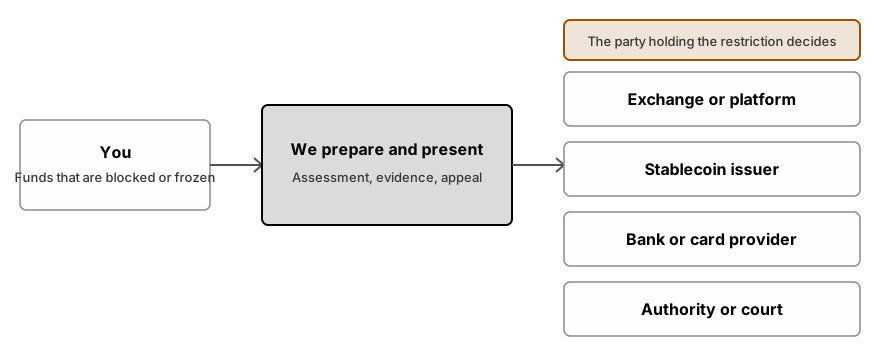
To prepare evidence, trace funds, or execute freeze requests, request a complimentary assessment. The written output determines assistance viability prior to fee citation. We do not influence authorities or platforms. We never request seed phrase, private key, or password.
Frequently asked questions
Is reporting required for low monetary value losses?
Report submission remains a user discretion, though beneficial. The FBI's IC3 mandates filing even with zero loss. A report contributes to the cumulative data used by authorities across victim groups and generates a required reference number for banks or exchanges.
What is the required order for filing reports to exchanges versus police?
Initiate both reports on the same calendar day. Speed is the critical factor over sequence. Exchanges can investigate retained funds, and police can issue reference numbers or formal platform requests. Retain every reference number.
Are there associated costs for submitting a crypto scam report?
Submitting a report is generally without cost. IC3 confirms legitimate law enforcement does not charge for services. Treat any payment request to file, accelerate, or 'unlock' a report as a potential scam indicator.
If jurisdiction is absent from the listed parameters, which official channel should be activated for reporting?
Begin with the national police or the designated cybercrime reporting centre. Check the issuing bank for recommended reporting channels. Obtain official addresses by manually navigating to a governmental website. This action prevents reliance on potentially malicious external links.
Does filing a report result in the recovery of the crypto assets?
Recovery initiation is not automatic. A submitted report creates a record and may influence platforms. Cryptocurrency transfers present inherent recovery difficulty once processed. No authority guarantees an outcome. However, documentation serves as necessary evidence for banks and mitigating further targeted incidents.
How we can help
- Support after a crypto scam. Structured help after a crypto scam: assess, document, trace, request freezes.
- Tracing stolen crypto, sending freeze requests. Tracing, freeze requests to exchanges and issuers, and police report support.
- Digital evidence prep for crypto cases. Collect chats, screenshots and records, log each item, arrange them for use by police, platforms or lawyers.
- Regulator and Ombudsman Filings. Construct a formal regulator, ombudsman, or consumer complaint including a precise timeline.
Sources
This record is derived from external, primary sources. Validation depends on the source documentation. Changes occur; review the originating platform for current content.
- Crime information: Cryptocurrency · FBI Internet Crime Complaint Center (IC3)
- Cryptocurrency fraud: how to report · Report Fraud (City of London Police)
- Reporting cybercrime and fraud · Canadian Anti-Fraud Centre
- Report a scam · Scamwatch, National Anti-Scam Centre (Australia)
- Filing a criminal complaint with the police (consumer centre guide, in German) · Verbraucherzentrale
- Online complaints office (in Spanish) · Policía Nacional (Spain)
- Consultation window for cyber incidents (in Japanese) · National Police Agency (Japan)
- Reporting economic crimes · UAE Government portal (u.ae)
The content on this page is general. It is not legal advice.